

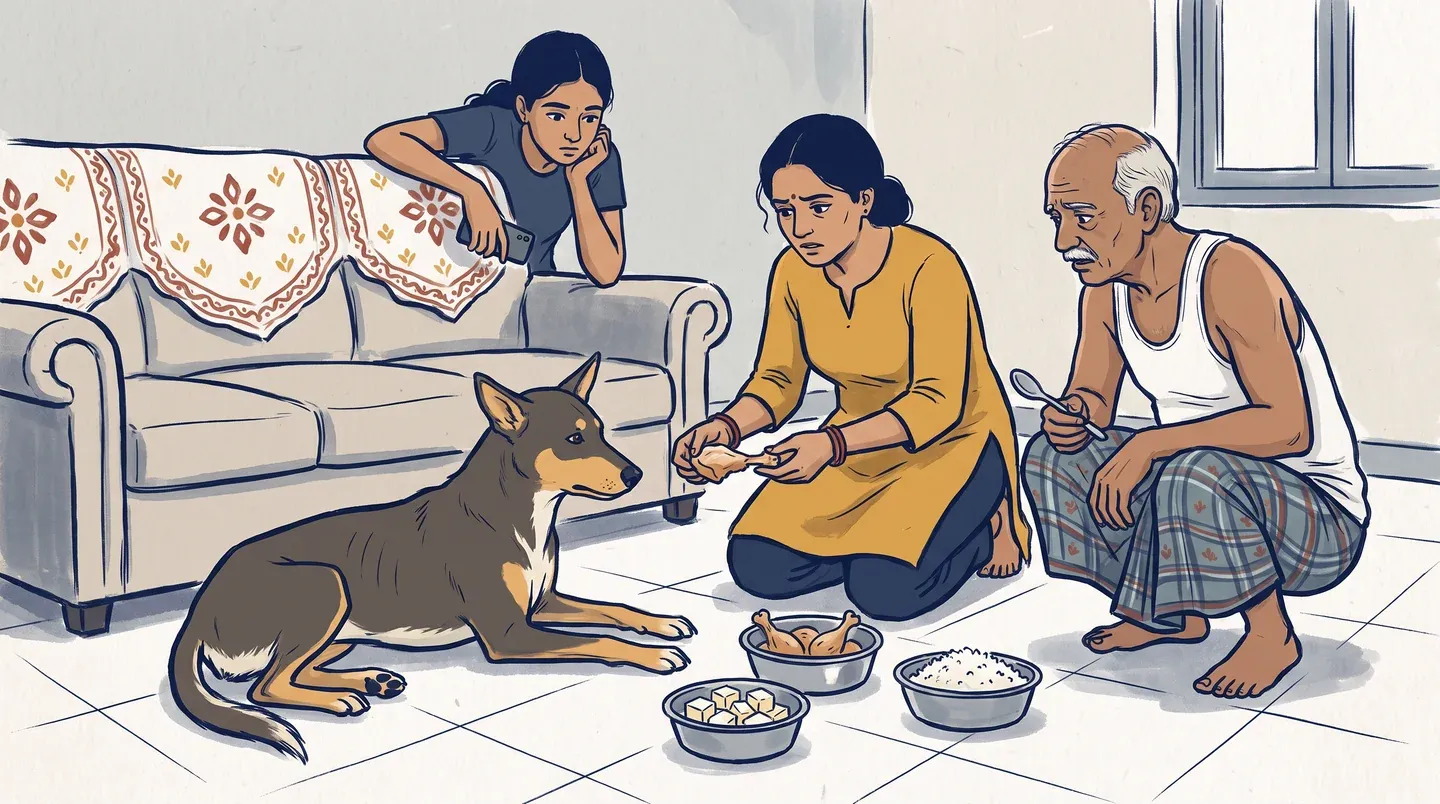
The calls about food came in two kinds, and they sounded like opposites. In the first, the dog had become dangerous around his bowl. He growled when someone passed it, he had snapped at a child who came too close, he guarded the kitchen door at mealtimes. In the second, the dog would not eat. The bowl sat there all day, the family tried chicken and then paneer and then hand feeding, and the dog turned his head away from all of it and was thin. Hyper at the bowl, anxious at the bowl, obsessed with the bowl, fussy at the bowl. Different symptoms, and very often one ritual, done the same wrong way. Very often, not always: each of those two dogs can need more than a ritual, and I will come back to both.
Done right, feeding does something no other ritual does quite as well. It makes a dog humble. Not small, not cowed. Humble in the way a dog in his own habitat is humble towards food, which he had to move for and which was gone when it was gone. A dog fed this way is calm when the bowl appears, confident that it will come, and he trusts the hand that brings it. That trust is one of the three legs from chapter 10, and food is where a great deal of it is built.
A fixed time
Start with the clock. His meals come at the same hours every day, and that is not for your convenience, though it will become convenient. It is because he has a clock inside him and no watch on his wrist.1
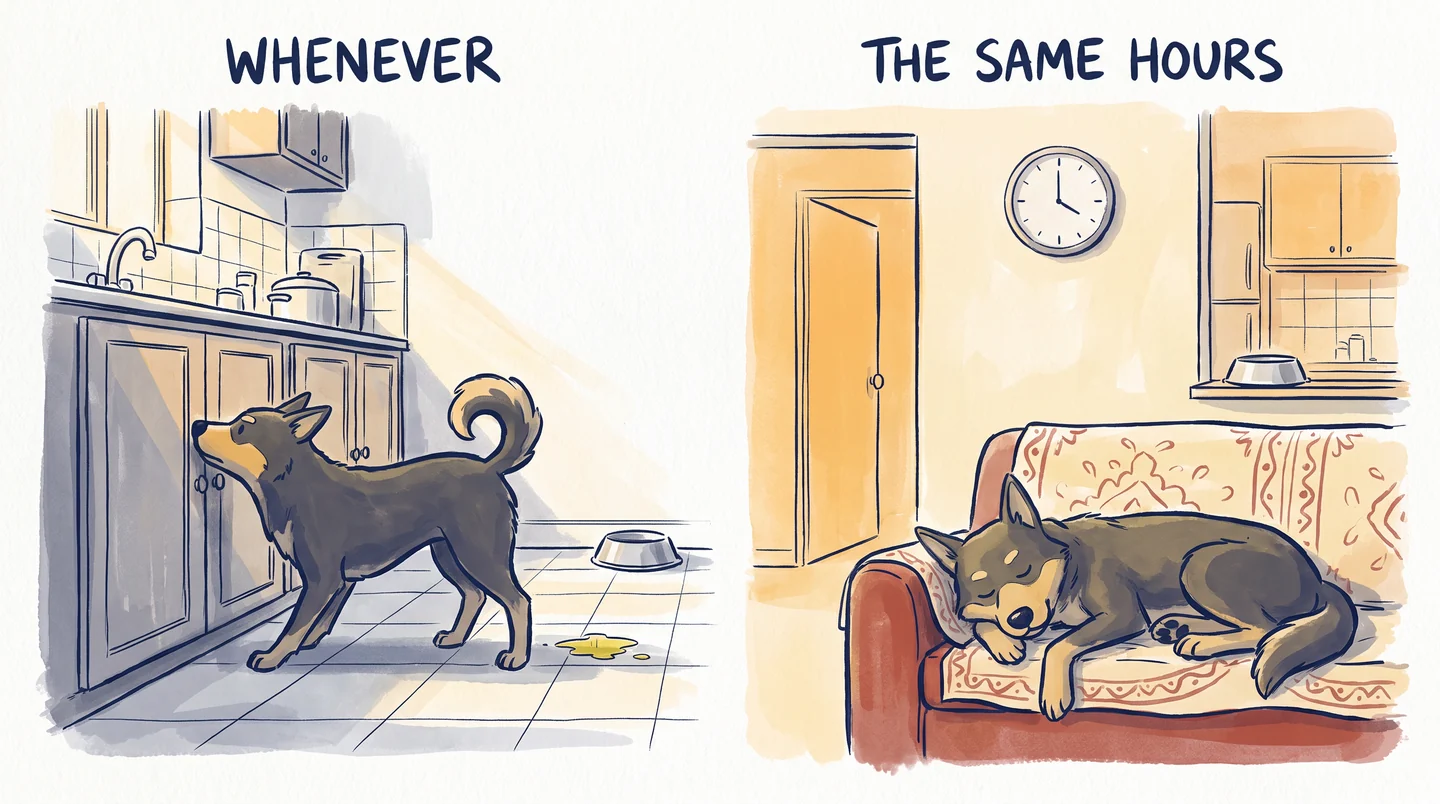
A dog whose food comes whenever somebody remembers does not know when food is coming. That is not a small thing to an animal. This is how I read it. When the first light hunger arrives, everything in him says go and hunt, because that is what hunger has always meant to his kind. He cannot hunt in your flat. If he is a confident dog, that becomes frustration. If he is not, it becomes anxiety: where is food going to come from. Either way, he spends the hours before the meal unsettled, and you see a dog who is restless in the afternoon and do not connect it to the bowl.
Fix the hour and the clock inside him learns it. He knows, without a watch, that food comes when it comes, and he waits for it calmly, and in the hours between he rests. You will see it in the body. A dog who knows when the next meal is does not have to think about food.
There is one more sign of the clock, and many families have seen it without knowing what it was. The dog vomits a little yellow foam, often early in the morning, on an empty stomach, and is otherwise himself. The yellow is bile. It comes back up from the gut into a stomach that has been empty too long, and it irritates it. Vets call it bilious vomiting, and what often helps is food at the right hours, sometimes with a small meal last thing at night, which is the one snack I would never argue with. So fix his meal times and keep them. But do not decide it is bile on your own. If he vomits more than now and then, if there is blood, or if he is off his food or losing weight, he goes to the vet, because other things look like this at first.
 , open the figure larger
 The rest of the Foundation
 The Six Rituals
 When Something Is Wrong