

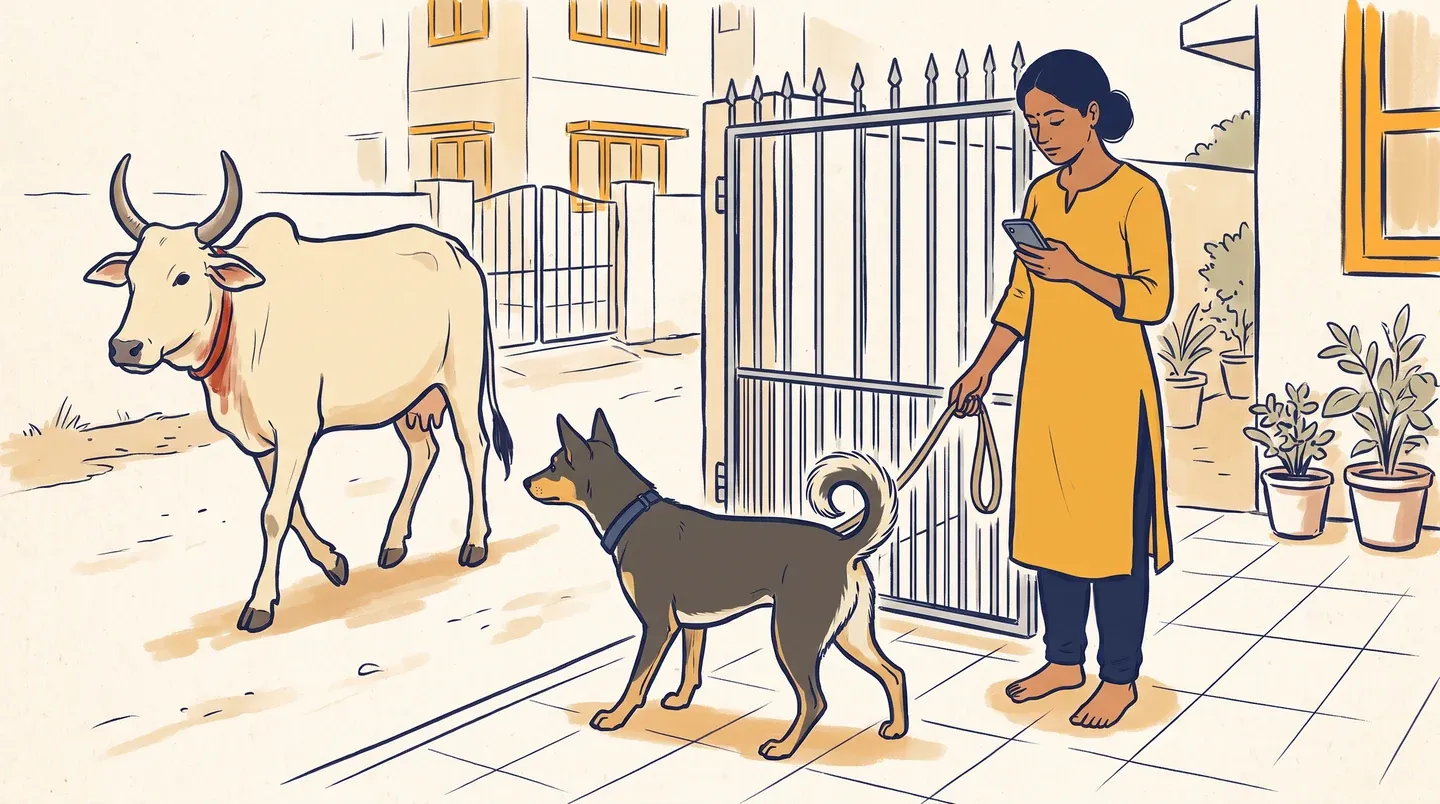
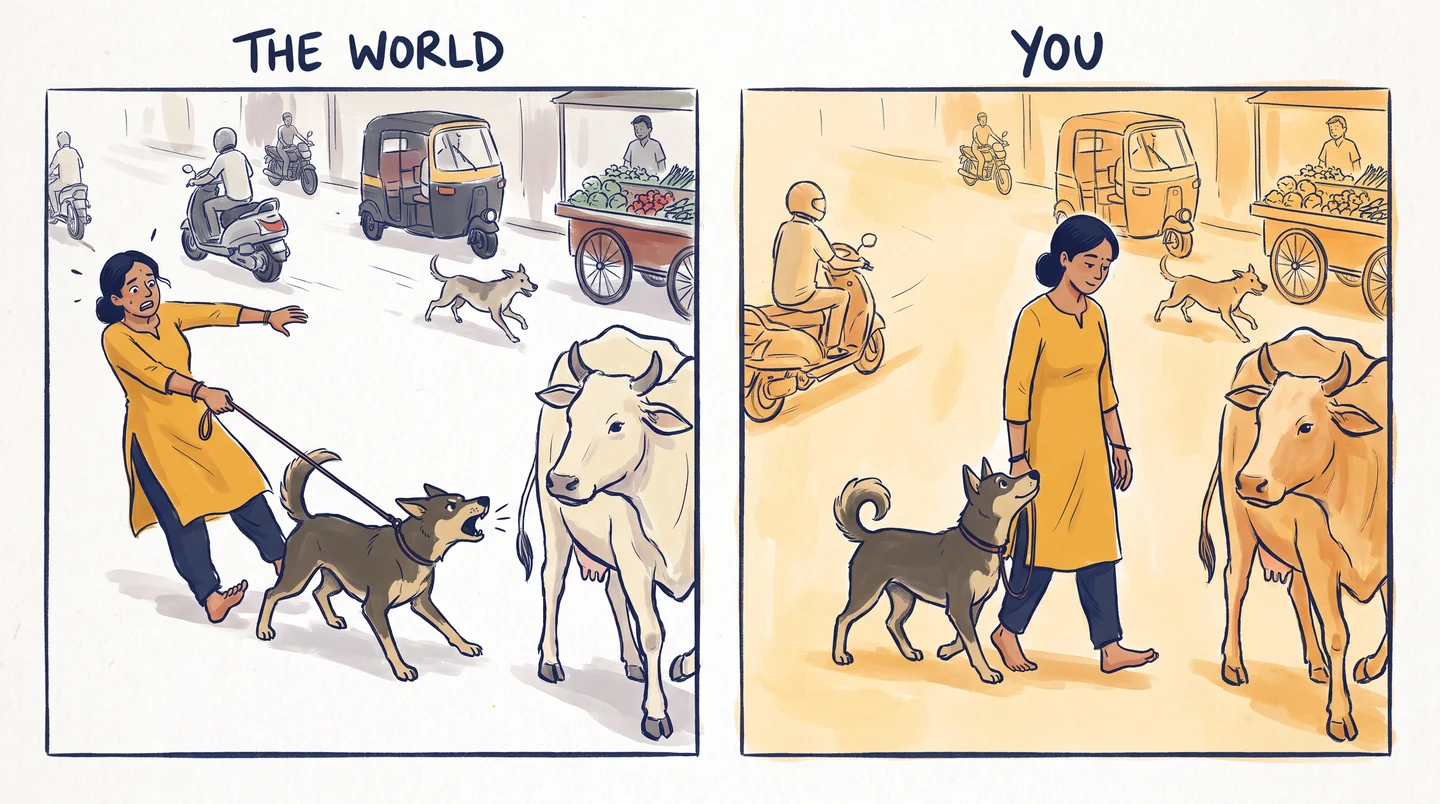
The bell rings and he barks. A cow passes the gate and he lunges. A stranger comes up the stairs and he hides behind your legs. A scooter backfires and he is off, dragging you with him. In every one of these the same thing has happened: something in the environment moved him, and you were a passenger.
I do not blame him for that. Look at what we have asked of him. In his natural habitat there are no doorbells, no horns, no leashes and no collars, no lifts, and no stranger reaching for his head on a staircase. The human world is far too complex for a dog to deal with on his own, and if we let the environment be the thing that moves him, he will develop issues, because the environment is not in anybody's control. The only thing in the house that is in anyone's control is you. So he has to learn that you are what moves him. Not the bell. You.
That is what focus on me means, and it is the foundation under everything in this book. Before sit, before stay, before any command, a dog has to be taught to look to his human for what happens next. In fact, every obedience command there is, if you look at what it is really teaching, teaches one thing: pay attention to me, not to that.1
 , open the figure larger
Not extra training
When I told a family I was going to teach their dog to focus on them, they expected a training session. A time of day, a set of commands, treats in a pouch. It is not that. You are not adding anything to his day. You are taking something he already does every day, the walk, and doing it a different way. By the time you have done it that way for a week or two, the lesson has happened without a lesson.
So this chapter is about the walk, and Part Two comes back to the walk in two chapters of its own, because the walk is where most of the parenting happens. But here I am only interested in one thing the walk does. It teaches him who he is attached to.
Let me describe the walk first, so you know the shape of the thing, and then we will go through it from the leash outward.
A structured walk is an exercise, the way going to the gym is an exercise, and like any exercise it has a shape. Fifteen minutes of brisk walking with him beside you or behind you. Then five minutes off, in which he can sniff, pee, roll, stand and look at the world, whatever he likes. Then fifteen more. Three or four of those sets, so the walk is forty-five minutes or an hour, twice a day, for a grown, healthy dog. Size it to him. A puppy, an old dog, a flat-faced dog like a Pug or a Shih Tzu, or a dog with a heart or joint problem gets shorter sets, and your vet tells you how short. In an Indian summer you walk at first light and after dark, you carry water, and you turn for home the moment he is panting hard or looking for shade. And at a fixed time, because a dog has a clock in him, and in his own habitat he would move at the same hours every day. In my experience a dog whose walk comes whenever someone remembers is more unsettled through the day, and a fixed time is one of the cheapest things you can give him.
Brisk means brisk. Most medium and large dogs move faster than we do, and nearly every human I have watched walks a dog too slowly, drifting, stopping, letting him sniff every pole, which is the pace at which a dog gets bored and starts looking for something to do. Walk like you are on a mission. You will feel better for it, he will feel better for it, and you will both be tired at the end in the good way. The sniffing is not lost. It has its own five minutes.
And it is not play. Play is a separate time with no structure in it, and we will get to it. The walk is your time together, with a shape, and the two get mixed up in most houses and that is where the walk goes wrong.
 The rest of the Foundation
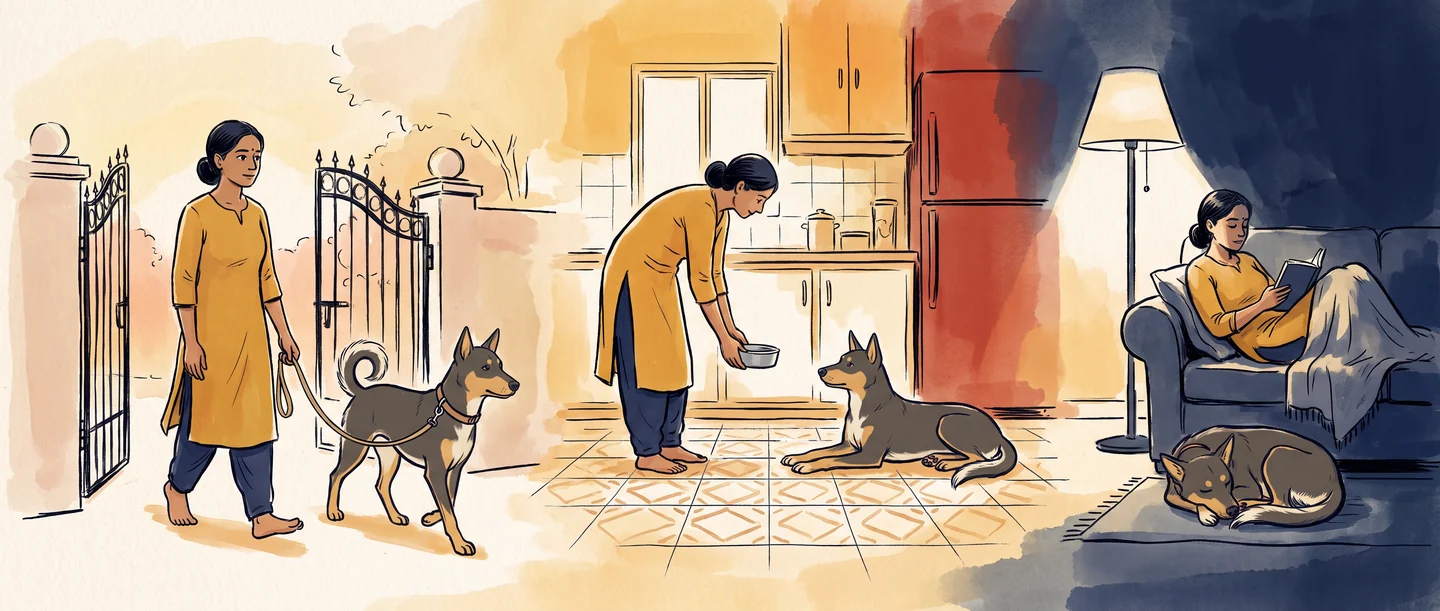 The Six Rituals
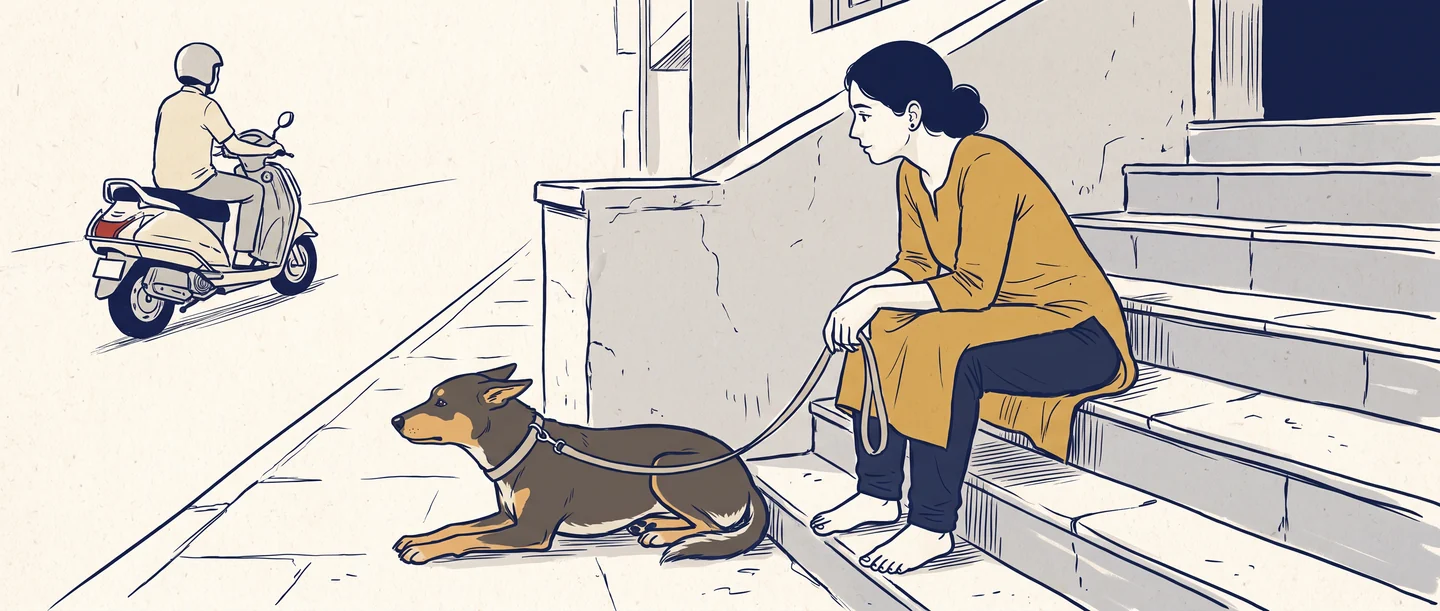 When Something Is Wrong