


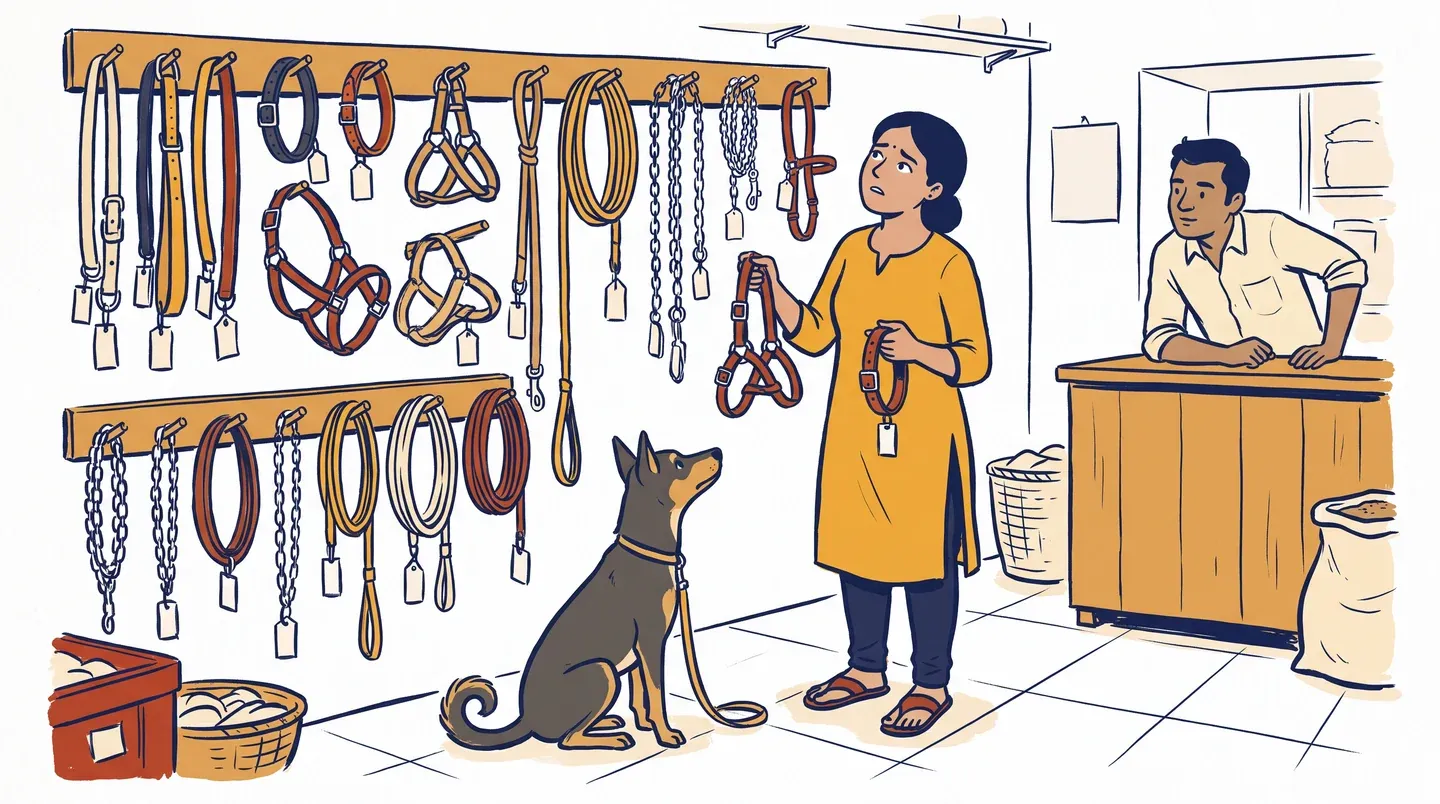
Before I show a family a single thing on the road, I talk about collars, because it is the question I am asked more than any other. People expect a product name. What I give them is a way of thinking, because the collar is not the magic. Your hand is, as the last chapter said. But the wrong tool makes your hand's job impossible: it puts pressure in the wrong place, it stops you reaching him in time, and the behaviour you bought the walk to fix gets bigger every morning. So the tool has to match the dog, and it has to match you.1
Six things people put on a dog
The flat neck collar. The one nearly every dog is wearing when I meet him. You buckle it once and it stays that size, so you cannot shorten it on the walk, and a dog who protests or panics pulls his head back out of it and is gone. From then on you walk afraid of that, and the fear is in your hand. Not while he is still learning to accept your guidance. Once he walks in structure beside you, it is fine. It was always only a place to hang the tag.
The harness. Many trainers recommend one, and they are right to worry about the neck. A collar on a slack leash presses on nothing. On a tight leash it presses on his throat, and studies of collars show that pressure can injure him. A harness keeps it off. So a collar is only as safe as the hand holding it, which is why this chapter is mostly about your hand.
My objection is a different one. A harness clipped on his back gives you no way to guide him. You hold a strap behind his shoulders, and he can look anywhere, smell anywhere, point his whole body anywhere. To guide a dog you have to move his nose, because where his nose goes his eyes go, and where his eyes go his attention goes. You cannot do that from his back. I have also watched, on dog after dog, an out-of-control dog in a harness with a frightened human hanging on behind him get tenser as the walk goes on. That is what I have seen, not what a study has shown, and the hand is as much of it as the strap. So for a healthy dog you are still learning to walk, I prefer a collar high on the neck and a hand that never holds it tight. At my socialising sessions every dog comes on a neck collar and a leash, and a muzzle when we are not sure of him. Once your dog walks beside you with nothing to correct, wear what you like.
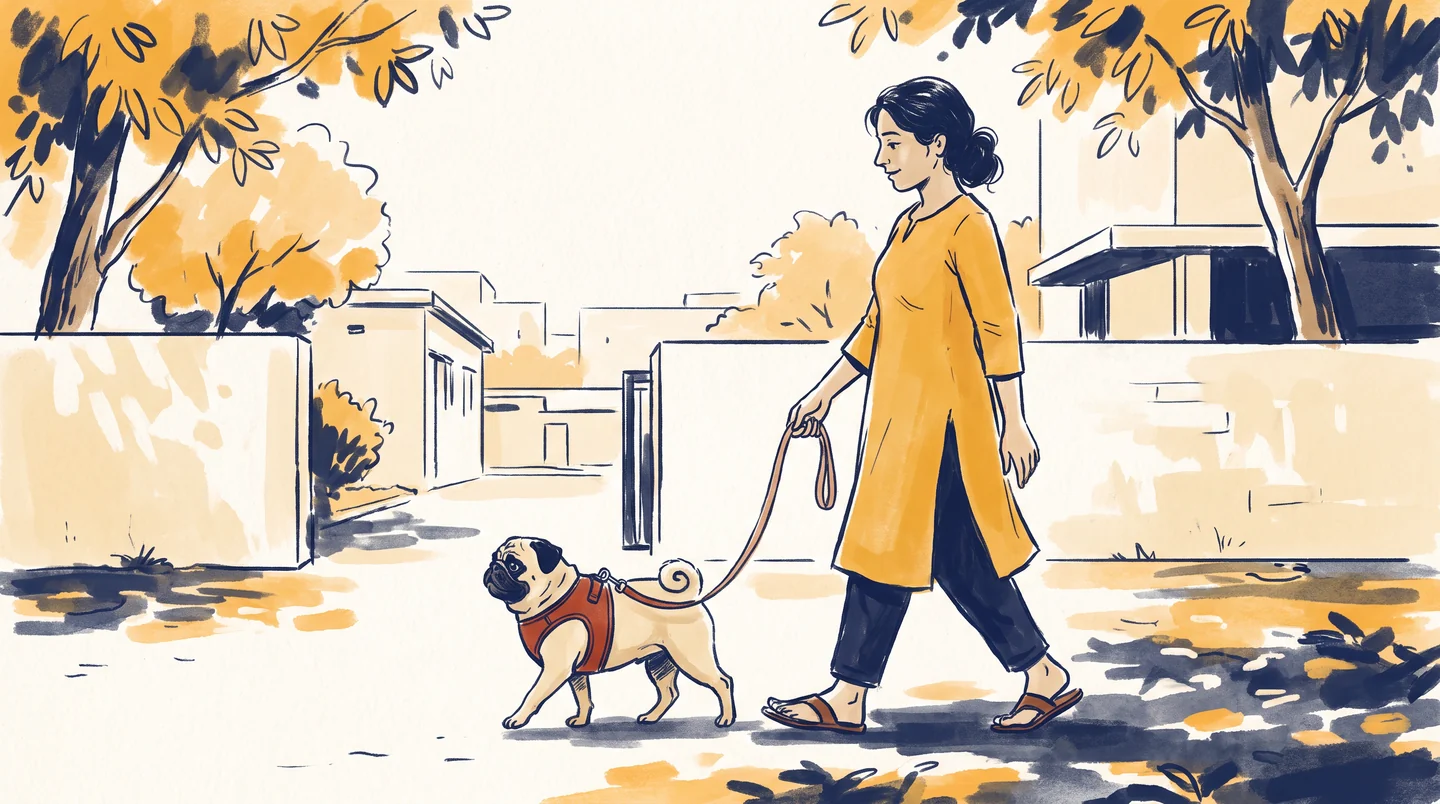
When a harness is the right answer. Some dogs should not have pressure on the neck at all. The toy breeds, the Pomeranian, the Yorkie, the Chihuahua, the toy Poodle, whose windpipes can collapse. The flat-faced breeds, the Pug, the Bulldog, the Shih Tzu, the Lhasa, who already work hard to breathe, because we bred them that way. Any dog with a neck or back problem, or an eye problem like glaucoma, because pressure on the neck raises the pressure in the eyes. A small-breed puppy. Any dog who coughs on a collar. For them, a well-fitted harness that does not tighten, chosen with your vet, and if he pulls, one with a ring at the chest, which gives you back some of the steering. Everything else in these chapters still holds for him: the short leash, your relaxed hand, beside you or behind you, the turn before the stare. A harness has ordinary jobs too: in the car he is tied through it to the seat belt, as chapter 20 shows. And for every dog on a collar, from the first walk: if he coughs, gags, or his breathing changes, stop and loosen. That is his throat.
 , open the figure larger
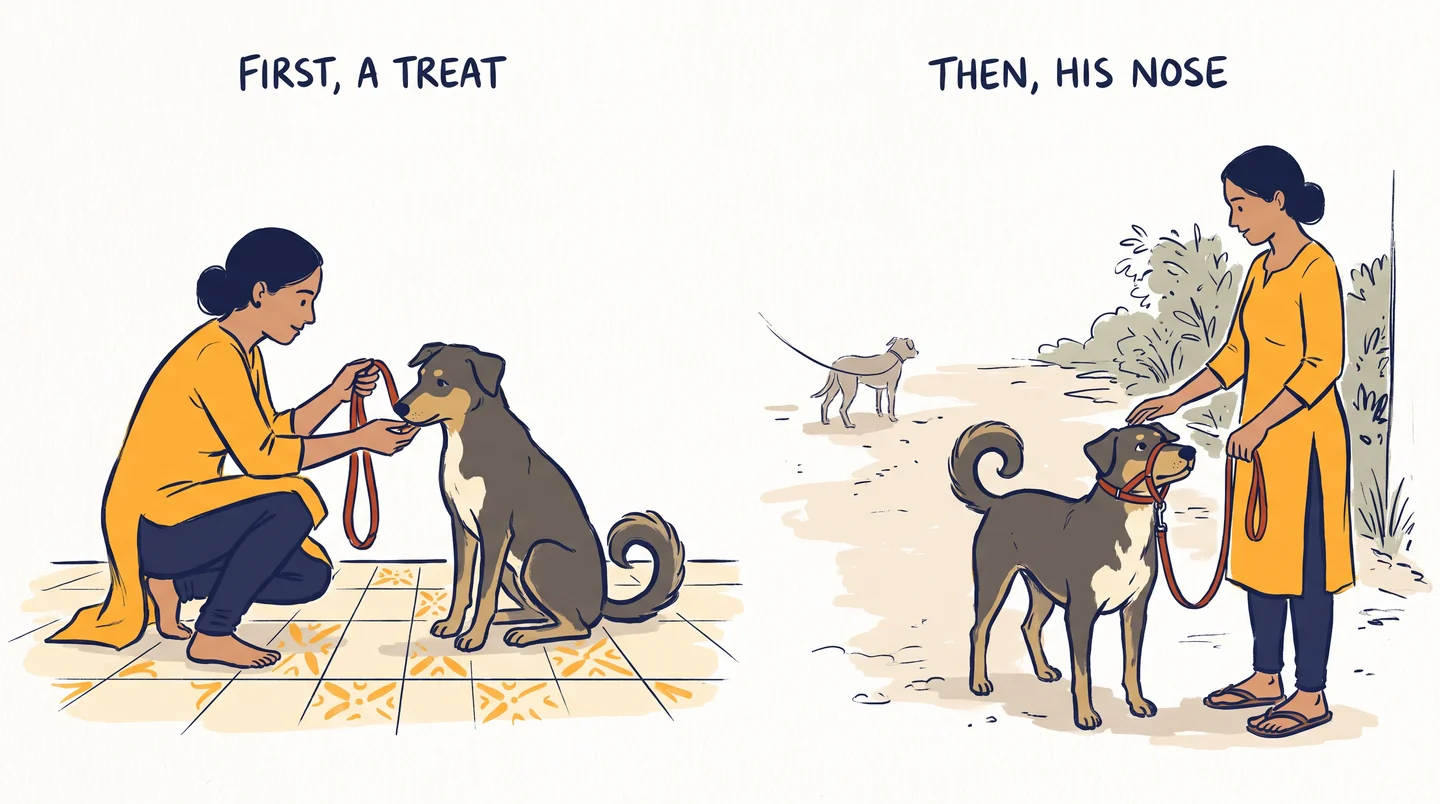
The halti. A loop over his snout, with the leash under his chin. This one I recommend, for some dogs and after some teaching, because it gives you his nose. If another dog comes and his eyes lock, you turn his snout gently to the side and his whole focus comes with it, the half second from the last chapter. It needs very little pressure and a very aware hand, because a hard yank on a halti can hurt him. So I use it with reactive dogs, only after the human has been taught it, and I teach the dog to like it first, a treat as it goes on, because most dogs paw at it at the start. It simply gives you his face.
 , open the figure larger
The martingale, in metal. A collar with a loop that tightens when he pulls and loosens when he stops. The metal ones are heavy, they rattle, and the links take a moment to close, so your message arrives late, and a tool that makes you late makes you unclear. I do not use them.
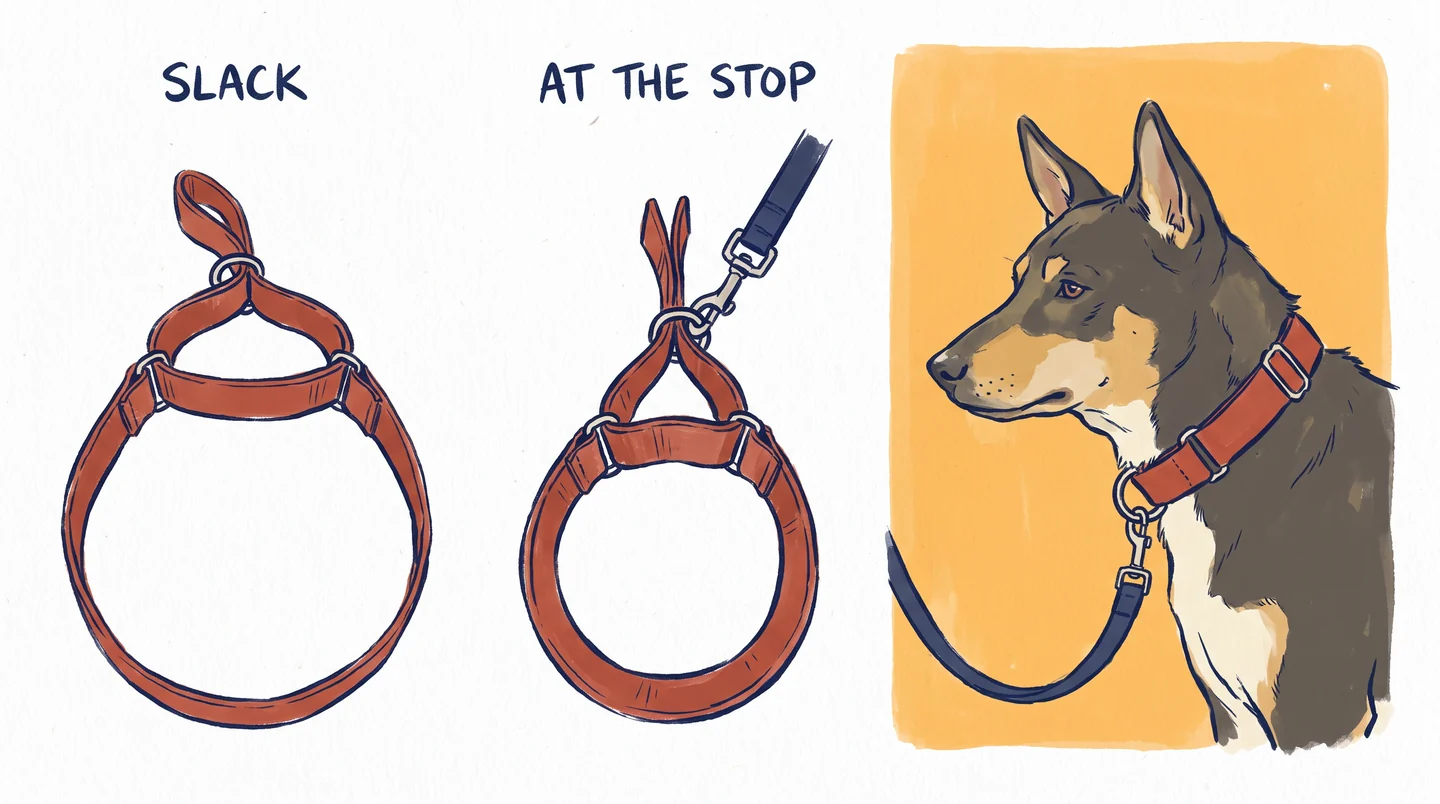
The martingale, in fabric. The same idea in a soft wide band. This is the one I give to nearly every beginner, and the one I use myself. It sits at the top of his neck and closes only as far as its stop, so he cannot back out, and when he settles it opens and you walk on. That takes the fear out of a new hand, because you are no longer walking with the thought that he might slip out and run. And it is wide, so a mistake lands more softly than on a thin cord. It is still a collar. When the leash is tight, his throat feels it.
 , open the figure larger
The slip leash. A leash and collar in one, a loop over his head that sits behind his ears. I used one for years, because it was less effort and the correction came faster. I don't now. A slip leash has no stop. It keeps closing for as long as the leash is tight, and it is thin, so a tense hand puts a great deal of pressure through it onto his throat. If a dog pulls back on one and coughs and vomits, all the confidence is gone, his and his human's. These days I use a fabric martingale. I know it will not choke him the way a slip leash can, even if he pulls, and knowing that makes my own hand calmer.
 The rest of the Foundation
 The Six Rituals
 When Something Is Wrong