

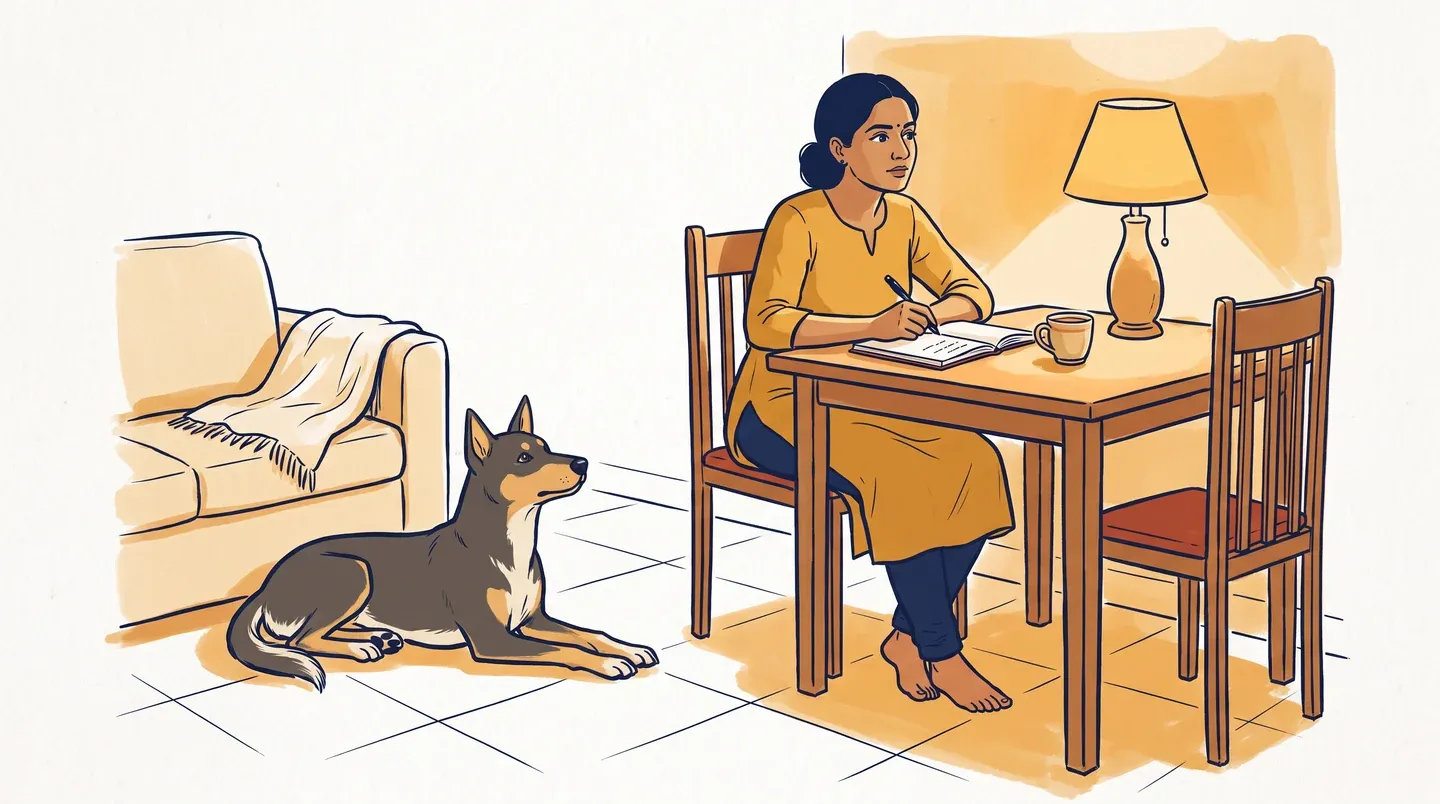
If you want to reach a place, the first thing you need is not the route. It is an honest answer to where you are standing right now.1 Every family that called me wanted the route. Tell me what to do, Sunny. And I always started somewhere else, with questions, because the route from a dog who pulls at the gate is not the route from a dog who growls at the bowl, and until I knew which dog was in the house I had nothing useful to say.
This chapter is that looking, done on your own dog, by you. It takes an evening. Then it gives you the first ninety days.
Six areas, and why only six
When I was taking consultations by the hundred, online and in people's homes, I noticed that I was saying the same things in house after house. Different breeds, different cities, different complaints at the door, and the same handful of sentences from me. If the problems were common, I thought, then the mistakes behind them must be common too. So I started writing down where the mistakes were, and they kept falling into the same six places.
The walk. How the dog meets people. Discipline in the house. Feeding. Play. Affection.
That is the whole list. People often tell me that I understand a dog very quickly, and some of that is years of looking. But most of it is that I am not looking everywhere. I am looking in six places, in order, every time, and a mistake in any one of them is enough to grow into the behaviour the family called about. Part Two of this book is these six, one ritual at a time. Here, we only ask about them.
Take them one at a time, and answer for your own dog. Write the answers down. Nobody reads them but you, so there is no reason to be kind.
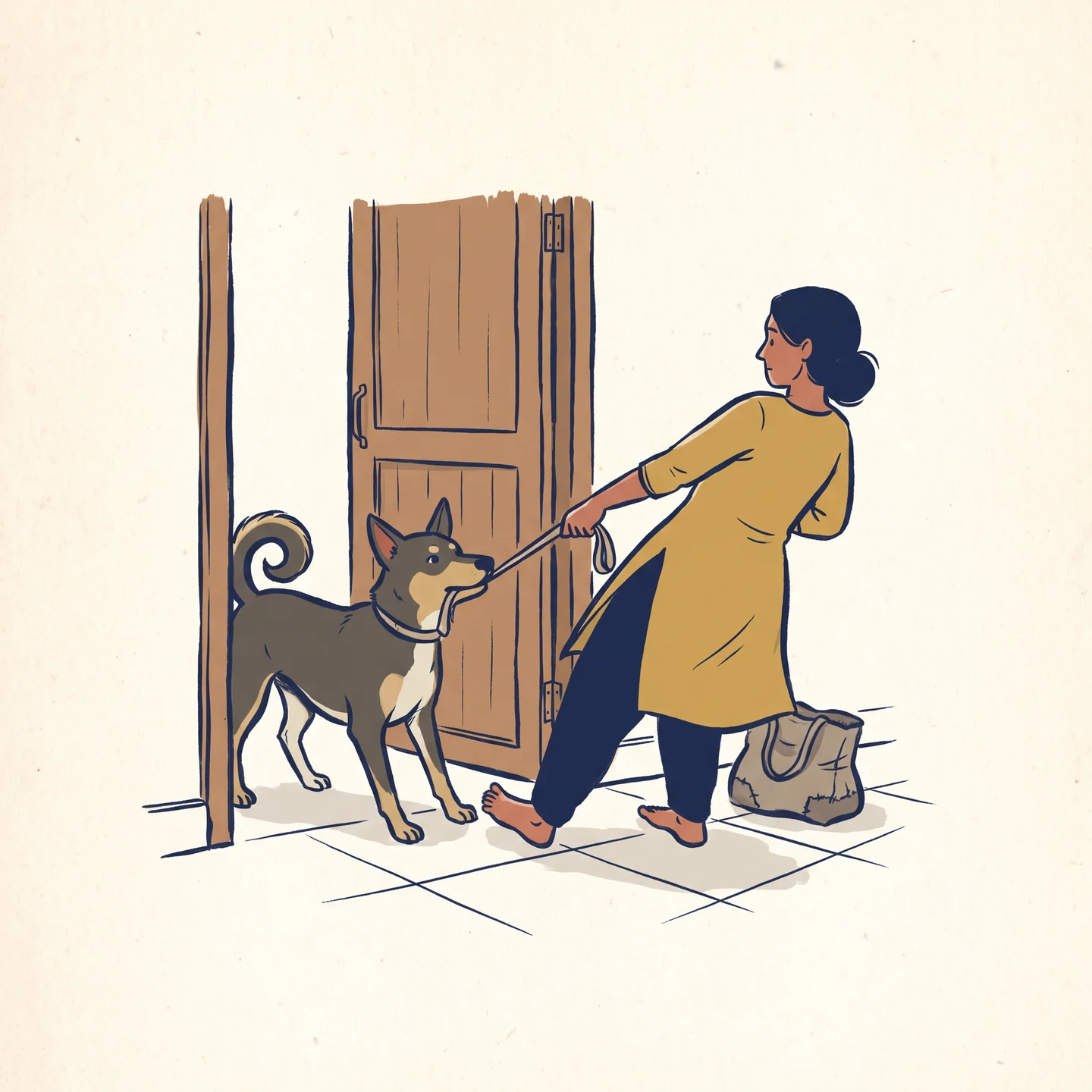
The walk. How does it start? When the leash comes out, is he calm or does the house erupt? Who goes through the door first? Once outside, where is he: beside you, behind you, or out in front with you attached to the other end? When another dog passes, what happens? And the question people never expect, which is about you: what do you feel on that walk? If the honest answer is tension, or frustration, or a small knot of fear every time a stray appears, write that down too. A dog who is out in front, deciding where the walk goes and what to do about everything it meets, has been given the job of leading. Almost every dog is born to follow, and in house after house I have seen the follower who leads become insecure, then start to claim the road, and out there that turns into going for other dogs. In the house it turns into destruction. The walk is where I look first, and chapters 11 and 12 are about nothing else.
 , open the figure larger
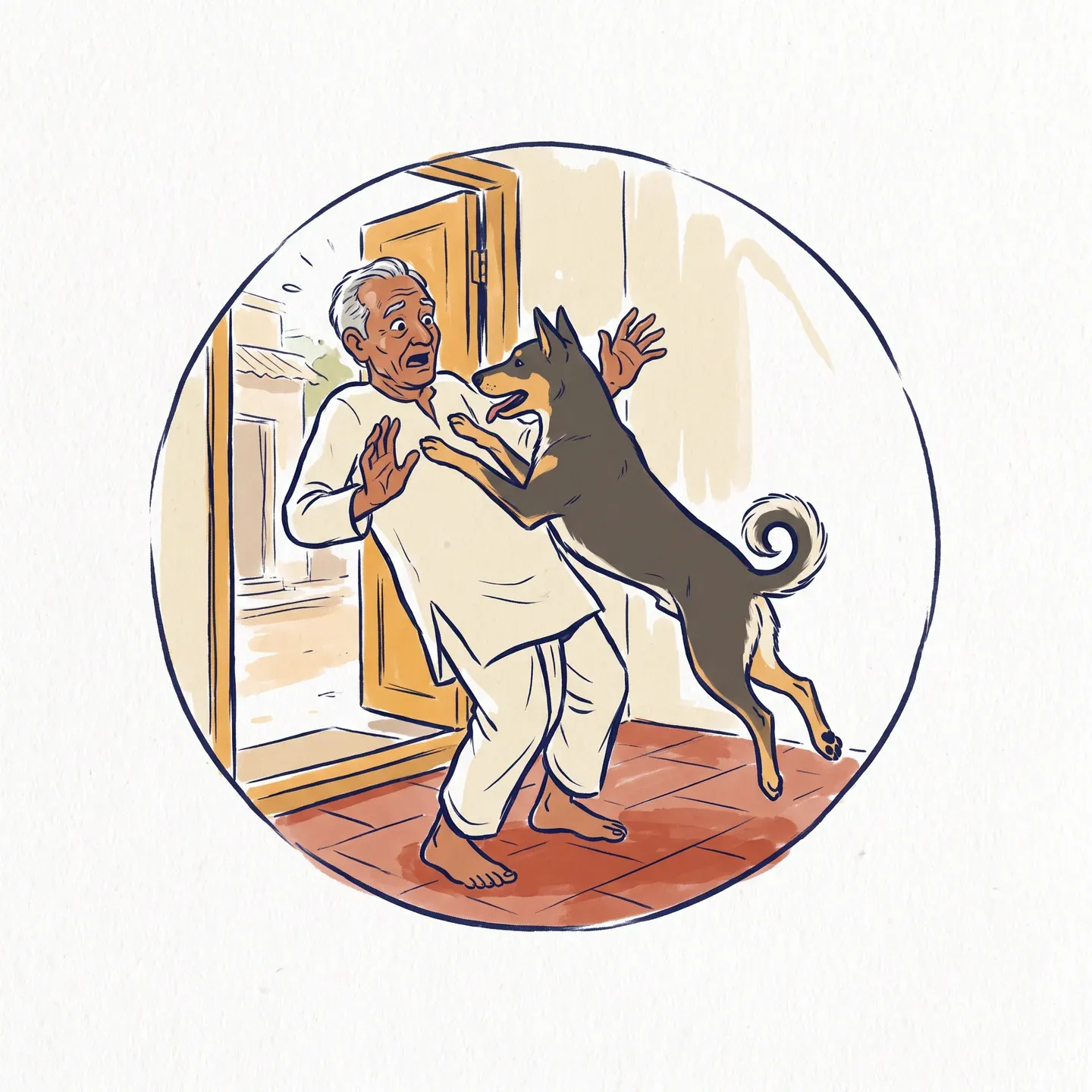
How he meets. You come home. He does what? Guests come, children come, an elderly relative comes. Does he give them distance and let them arrive, or does he throw himself at them? Most families read the throwing as happiness. It is not. It is excitement, and we met the difference in chapter 01. A dog who meets everyone at full charge starts to become territorial around the door. He is more alert when the bell rings, he may start marking inside, and one day he is not greeting the people at the door but seeing them off.
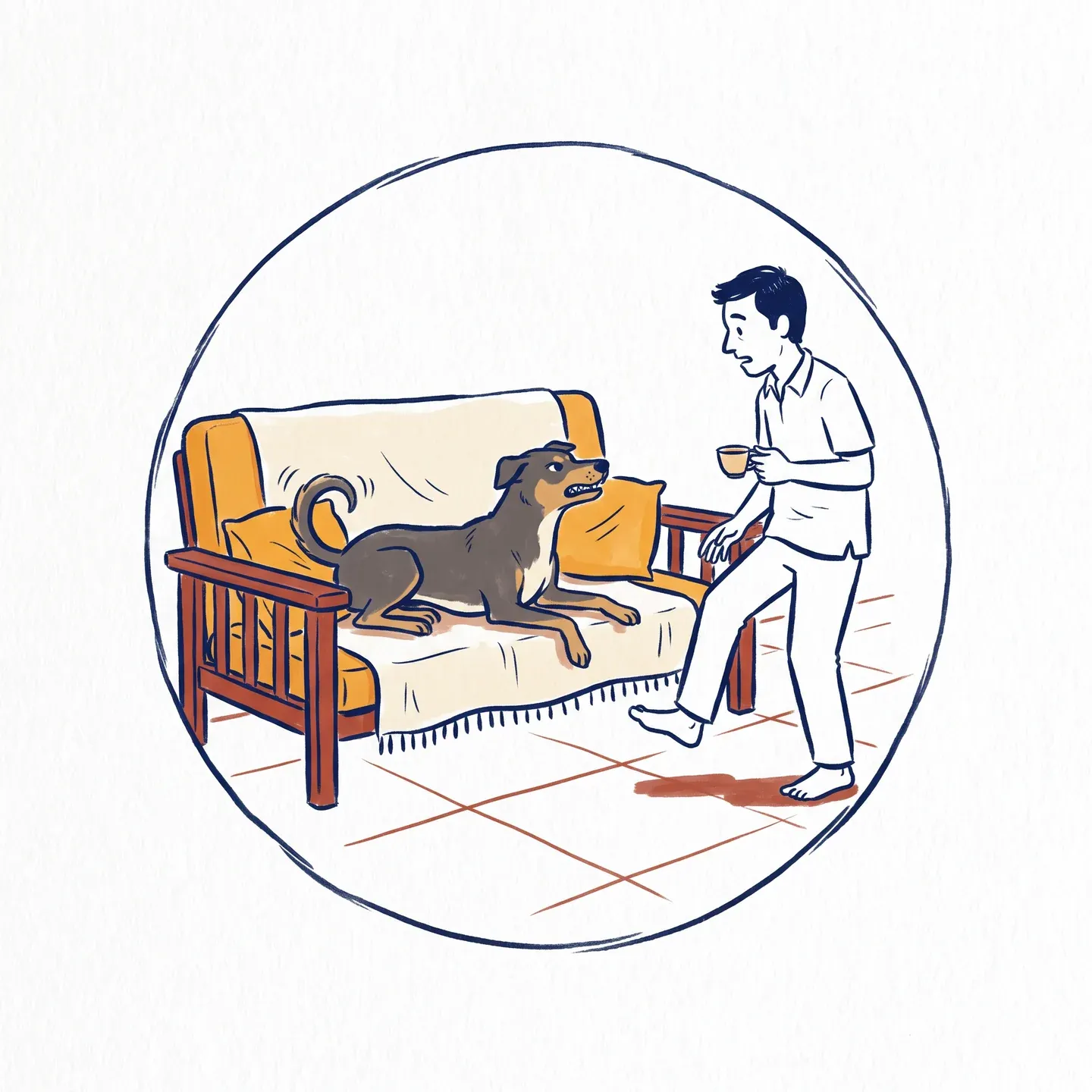
Discipline. Are there rules in the house? Not in your head, in the house, so that the dog knows them. Is the kitchen his or not? Does he go onto the furniture by right, or does he ask? When he is on the sofa and someone comes near, does he give way, or does he grumble? When you tell him to move, does he? If he follows the rules you set, you are doing something very right and you should know it. If the rules are there and he ignores them, or there are no rules at all, then as far as he can tell the house is his territory and everything in it is his to protect. That is where the chewed door frames come from, and the growl at the person who sat in his place. One more thing, which I learned on calls with the people I train: inconsistency is worse than too little. A dog with no rules is not confused, he simply knows that whatever he wants, he gets. A dog whose rules change with your mood is confused all day.
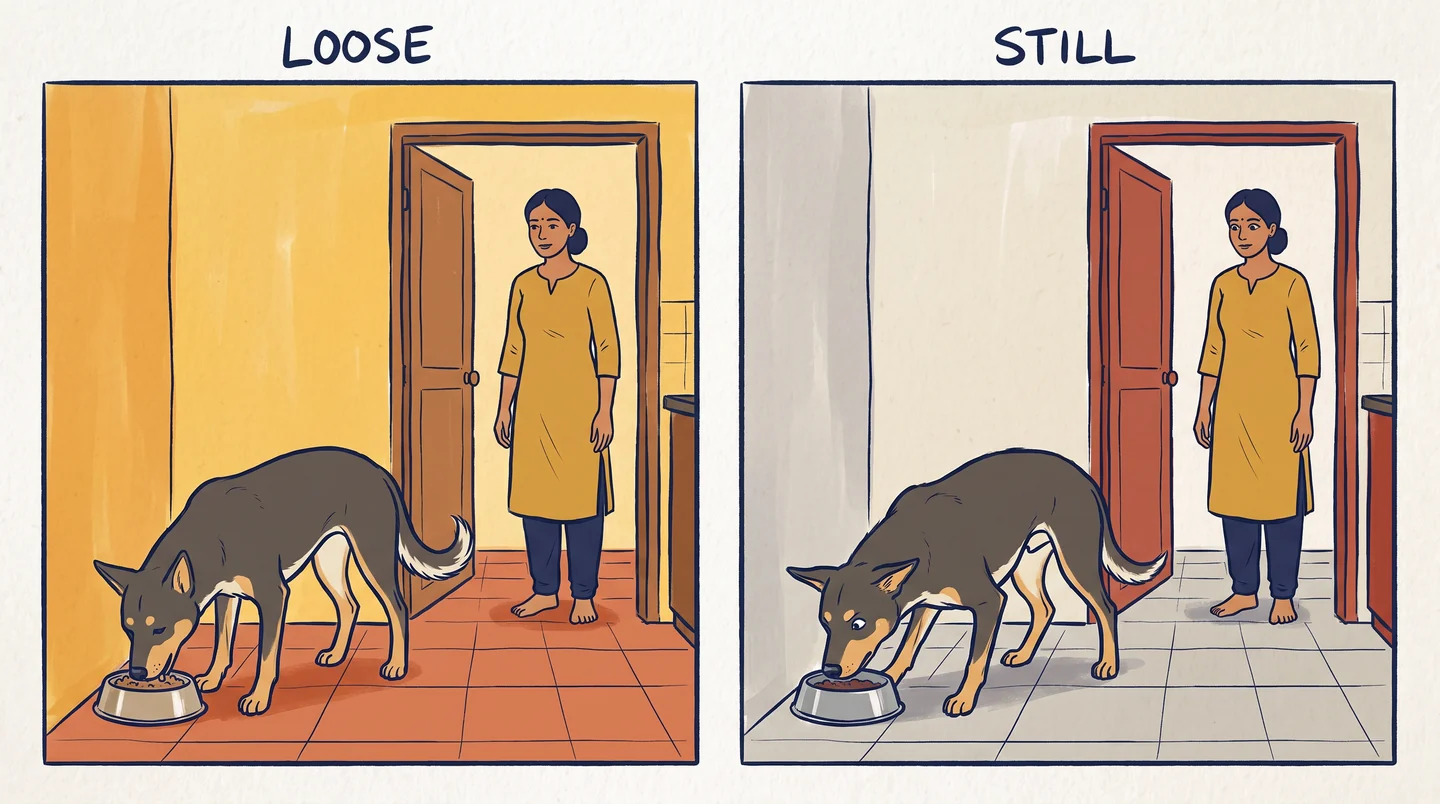
Feeding. When the bowl comes out, what state is he in? Hyper and jumping while you fill it, or anxious, or is he the dog who walks away from food and has to be coaxed? Does he eat in a quiet corner, or in the middle of the house with people walking past? Is food lying on the floor all day? Then put the bowl down and watch from where you stand. Does he eat loosely, or eat faster when someone comes near, go still over the bowl, watch you from the side of his eye? Only watch. Do not walk up to test him and do not put your hand near the bowl. In the houses I have worked in, the dog wound up at feeding time is the one who starts to guard, and the hand that comes in to take makes it worse. As I said on a call in September, this snatching starts creating snapping.
 , open the figure larger
If he already stiffens, growls or snaps over food, change something today. He eats in a room of his own with the door closed. No children near him while he eats. Nobody takes the bowl from him, ever. And get someone who knows this work to see him, with a vet check for pain. Guarding is one of the commonest ways a child gets bitten by the family's own dog, and it does not fade because you wait.
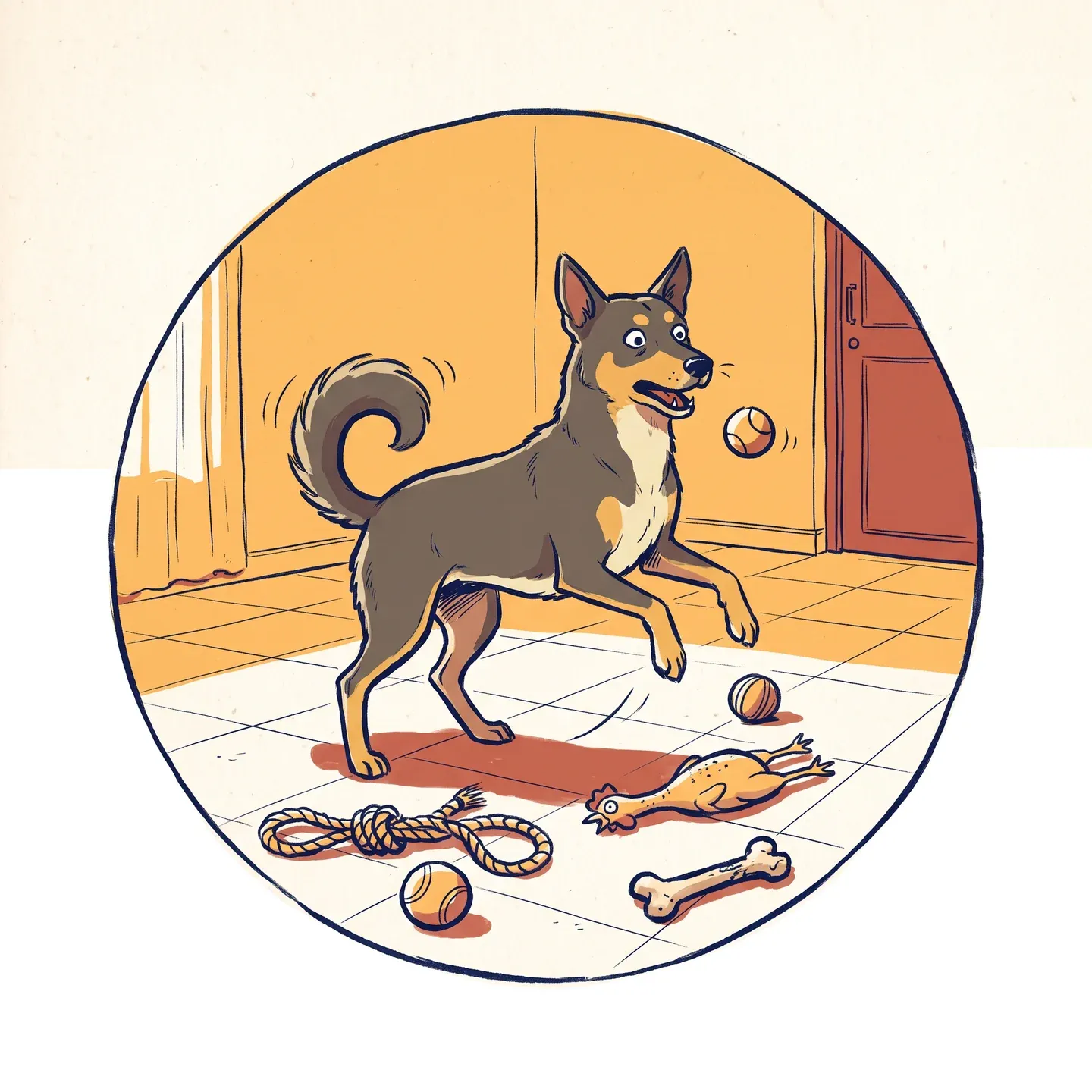
Play. Is there a time for play, or does it happen whenever? Do you play with him, or does he have toys? A toy is not play. Dogs play with each other, and a dog who has nobody to play with has a need going unmet every day of his life. Watch the play itself: does he get so wound up that he comes at you, do the zoomies take over and you cannot bring him back down? And is he playing all day? A dog who plays by himself from morning to night is not a happy dog. He is a dog with energy that nobody is spending, practising excitement all day long, and excitement behind four walls becomes separation anxiety the day you leave him alone in them.
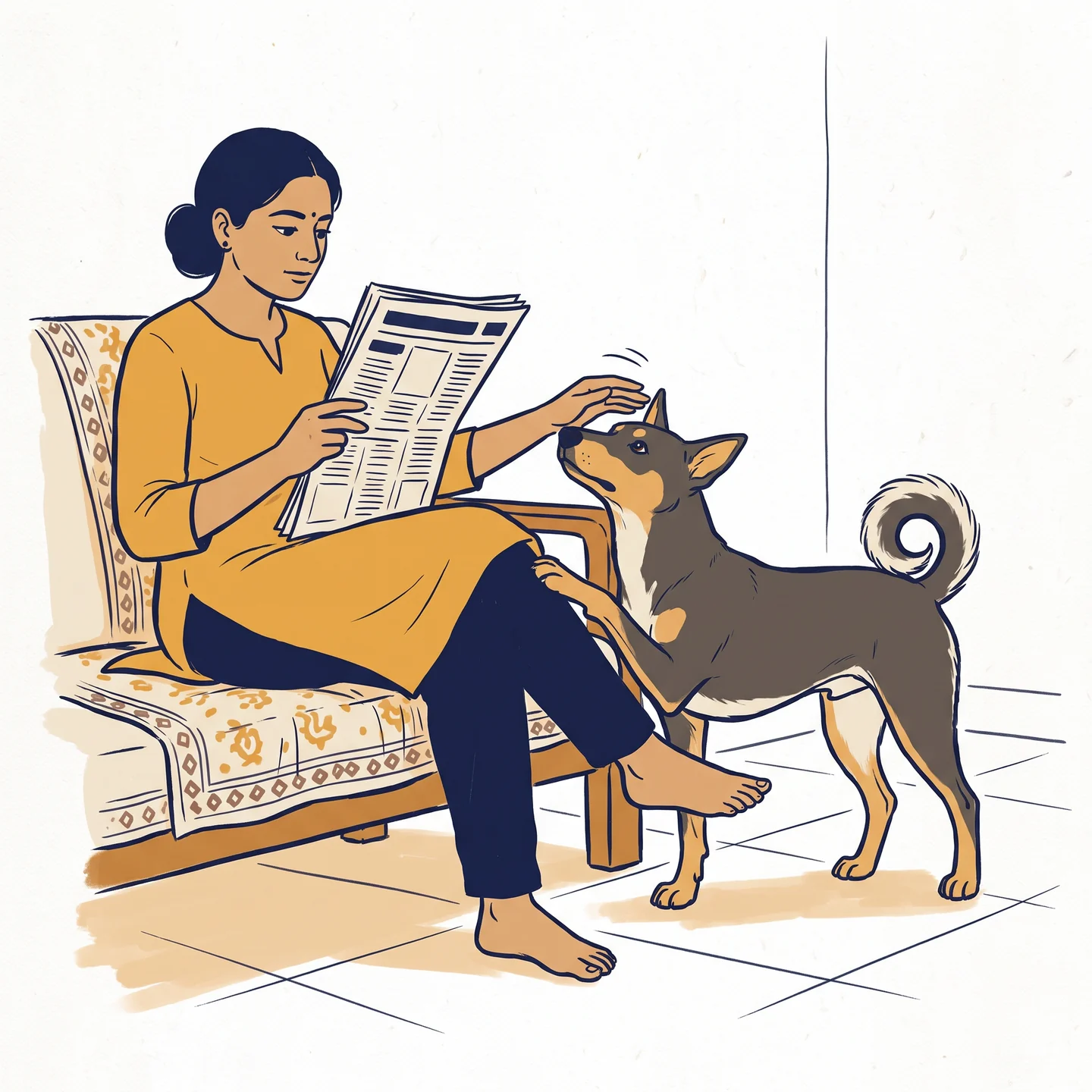
Affection. When do you give it? And this is the one that surprises people: does he demand it? The nose under your hand, the paw on your knee, the head pushed into your lap until you touch him. It looks like love. It is a demand, and love should not have to be demanded. A dog who demands affection and gets it is building an obsession, and obsession turns into claiming. This is the dog who is perfectly fine with you until someone else comes close, and then goes for them. The family tells me he does it because the two of them are so close. That is not the reason. He claims you, and you reward the claiming, and so he defends what he has claimed.
 , open the figure larger
Issues start small
Nobody's dog became aggressive on a Tuesday. He arrived there one small step at a time, and the steps were visible, and nobody saw them, because nobody knew where to look. By the time a family sees anything, they are seeing the bite, or the lunge, or the full-grown fear, and they say he suddenly changed. Usually he did not. But if it really was sudden, a dog who was easy last month and snaps today, take him to the vet first. Pain is behind more growling than people think. Most of the time, the first symptom was in one of the six rows above, months earlier, and it was small enough to live with.
That is why this evaluation matters more for the dog who seems fine than for the one who already has an issue. If you have the issue, you know you have work to do. If you have the puppy who jumps on guests and gets laughed at, you have the same work and no idea yet.
Let me show you how the six questions do their job, with a case from one of my calls with the people I train.
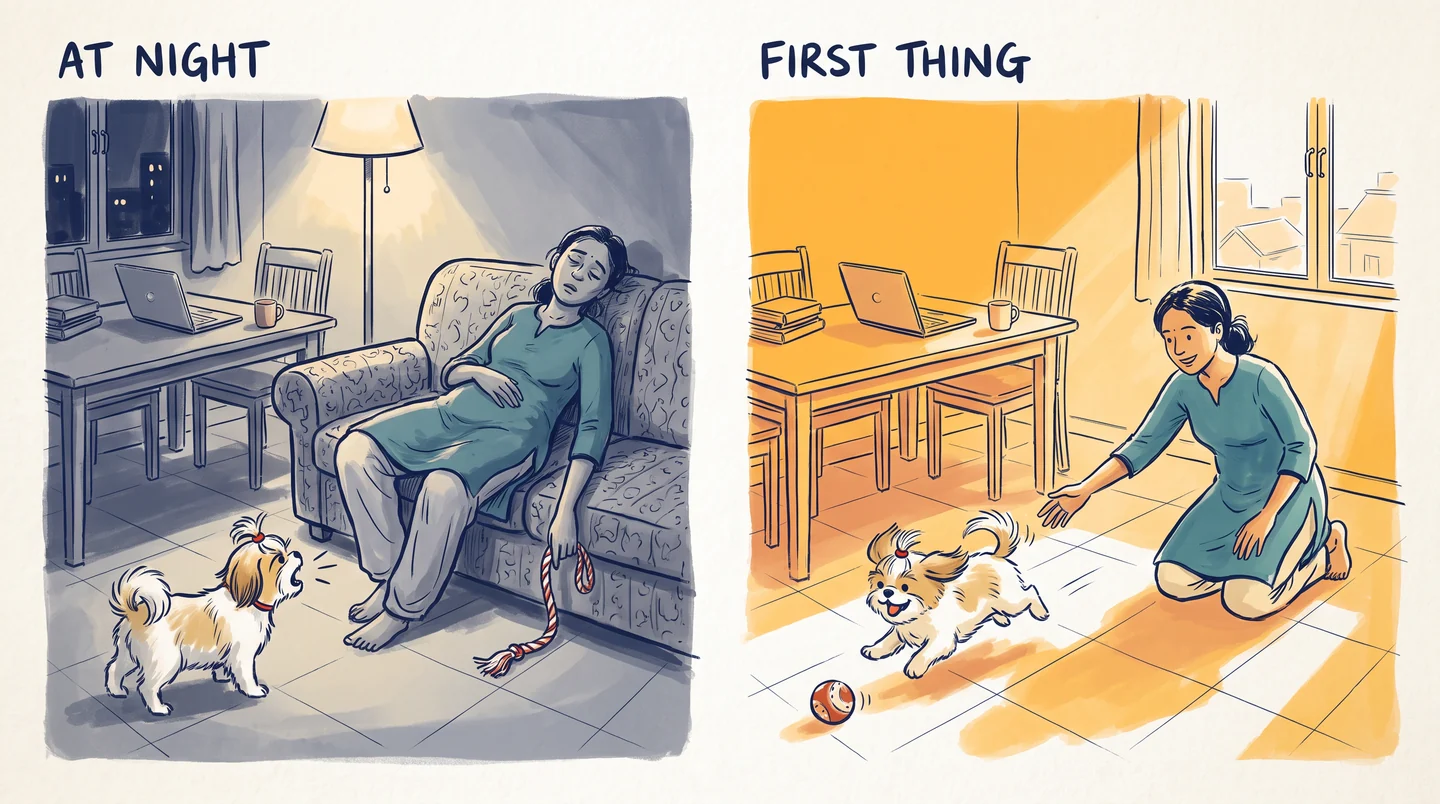
A Shih Tzu, eight or nine months old, barking at her human from morning to evening. Not at guests, not at the gate. At the one woman she lived with, who worked from home and could not get through a day of it. The dog had been to a behaviourist already. Her walks were good and structured, she was obedient, she destroyed nothing. The barking continued.
I gave the case to the group and asked them to find the cause, and within a minute almost everyone had said the same word: attention. She wants attention. I stopped them, because I have taken that word out of my vocabulary. Everything a dog does is for attention. When he sits near you, when he looks at you, when he puts his paw on you, he wants attention, and we call none of that a problem. We only reach for the word when the behaviour annoys us, and so the word explains nothing. What I wanted from them was not an answer. It was data.
So we asked, in order. Walk: fine, already handled. Meeting: she lived alone with the woman, no excitement at the door. Discipline: rules in place, followed. Feeding: twice a day, on time. Affection: the woman was reserved by nature, no over-petting. Play: once a day, at night, for fifteen minutes to half an hour, when the woman was finished working and tired.
There it was. A dog of eight or nine months with a full day's worth of play in her, and one session, at the wrong time of day, with a human who had nothing left to give. The barking was sharp and repetitive, a frustrated bark, and the little shifting from paw to paw underneath it was a dog asking to play. The behaviourist before us had kept adding walks. We did the opposite. Fewer walks, and play three times a day, starting first thing in the morning when the woman was fresh and could actually play rather than go through the motions. The barking stopped. Not from obedience, which she already had, and not from exercise, which she already had. From the sixth question, asked properly.
 , open the figure larger
If you run the six questions on a dog and still cannot see it, you have not run out of data. You have found a gap in what you know about dogs, and the rest of this book is for that. But most of the time you will not need it. Most of the time, the answer is sitting in one of the six rows, and it was always there.
The dog, the human, and the pair
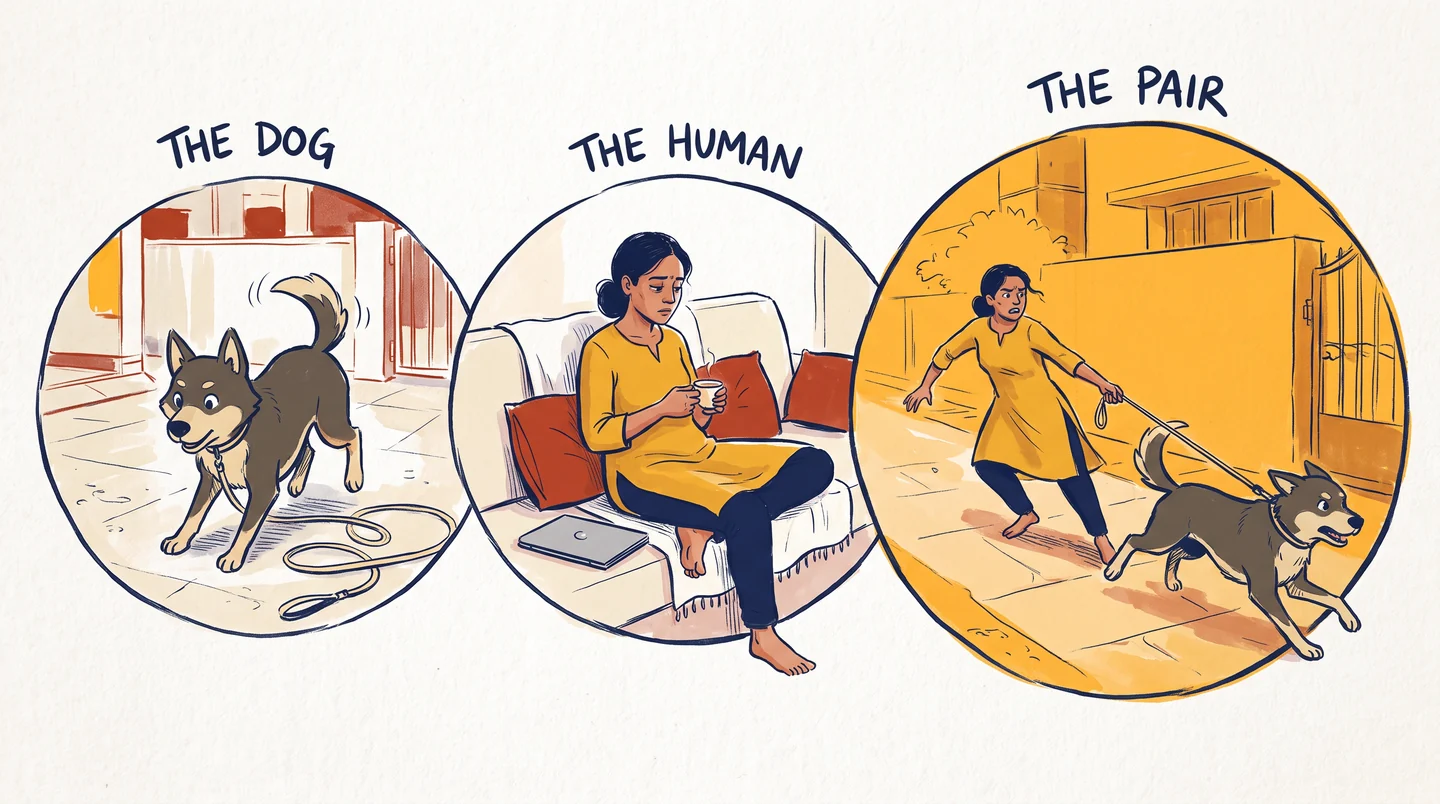
When I evaluate a dog, I am never only evaluating the dog. I tell the people I train that there are three assessments, not one.
 , open the figure larger
The dog first: his intensity, which we will properly sort in chapter 03, his age, what he is like after the walk. Then the human, honestly: your energy, your routine, what you feel on the leash, how much of your day you actually have for him. Then the pair, which is the one nobody asks about. A medium-energy person who has brought home a high-energy dog is going to be overtaken, not because either of them is wrong, but because they do not match yet. Either the person's energy comes up or the dog's comes down, and usually both. You cannot see that in the dog alone.
So when you have written your six answers, read them again as if they were about you. In most of them, they are.
Ninety days
Now the plan. The course that this book grew out of gives it on day one, and it is simple. It is as simple to do as it is to not do, so hold on to it.
Ninety days, because dogs and humans are both creatures of habit.2 In my experience it takes about three months for a new habit to settle in, for the dog and for the family, until it holds without anyone pushing it. So I plan every rehabilitation on ninety days. I have had families give a change one week and come back saying it did not work. It had not failed. It had not been given time to start.
The plan has three parts.
The first three days: learn, and change nothing yet. They are for reading. Chapters 01 to 03 are free, and the rest of Part One is in the book. If you only have these three, read them twice and start the routines on day four. Read before you start rearranging your dog's life, because the rituals in Part Two only make sense once you know what a dog is and how he reads you. The temptation is to skip ahead to the doing. Resist it for three days. Absorb, write down what surprised you, and let it settle.
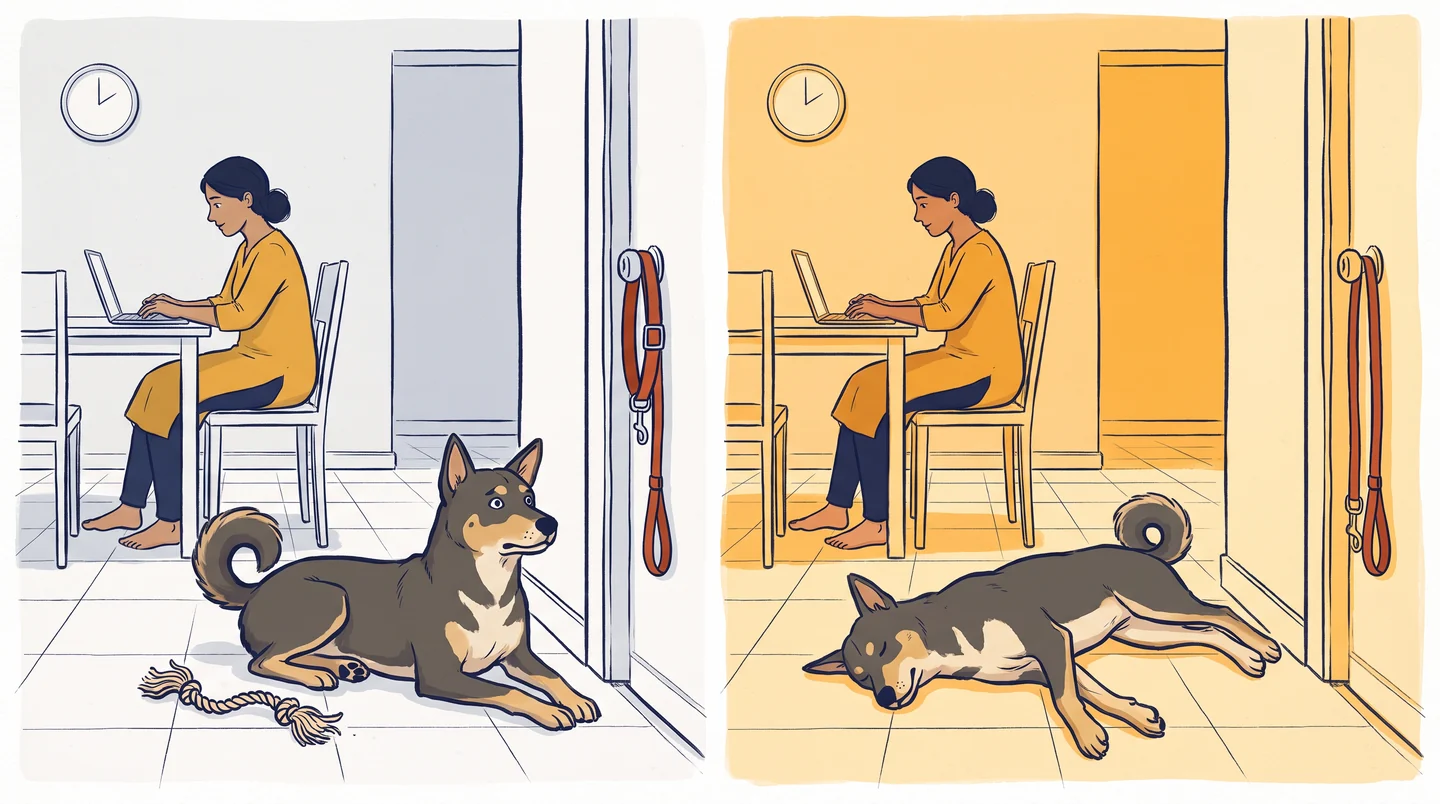
Then fix three routines: the walk, play, and feeding. Not vaguely. At what time, and for how long. A dog has a clock inside him, and when he does not know when the door opens he starts to carry a question around all day: when am I going out? Am I going out? A dog who knows when the door opens can put the question down and settle in between. Set the walk's time and its length. Set a time for play, and make it play with you, every day, fifteen to thirty minutes, not a toy left on the floor. Set the feeding times. You can move them a little when life demands it, but the shape of the day should be something he can count on.
 , open the figure larger
This is prevention, but it is also the first thing I do in every case that already has an issue, whatever the issue is: anxiety, aggression, nervousness, a dog who has gone flat and dull. We set the routine. And you will notice something in yourself at the same time, because you are a habitual creature too. When your day has a shape, you wake up knowing what it holds, and you wake up with more confidence and more clarity. The routine is not a cage for the dog. It is the floor you both stand on.
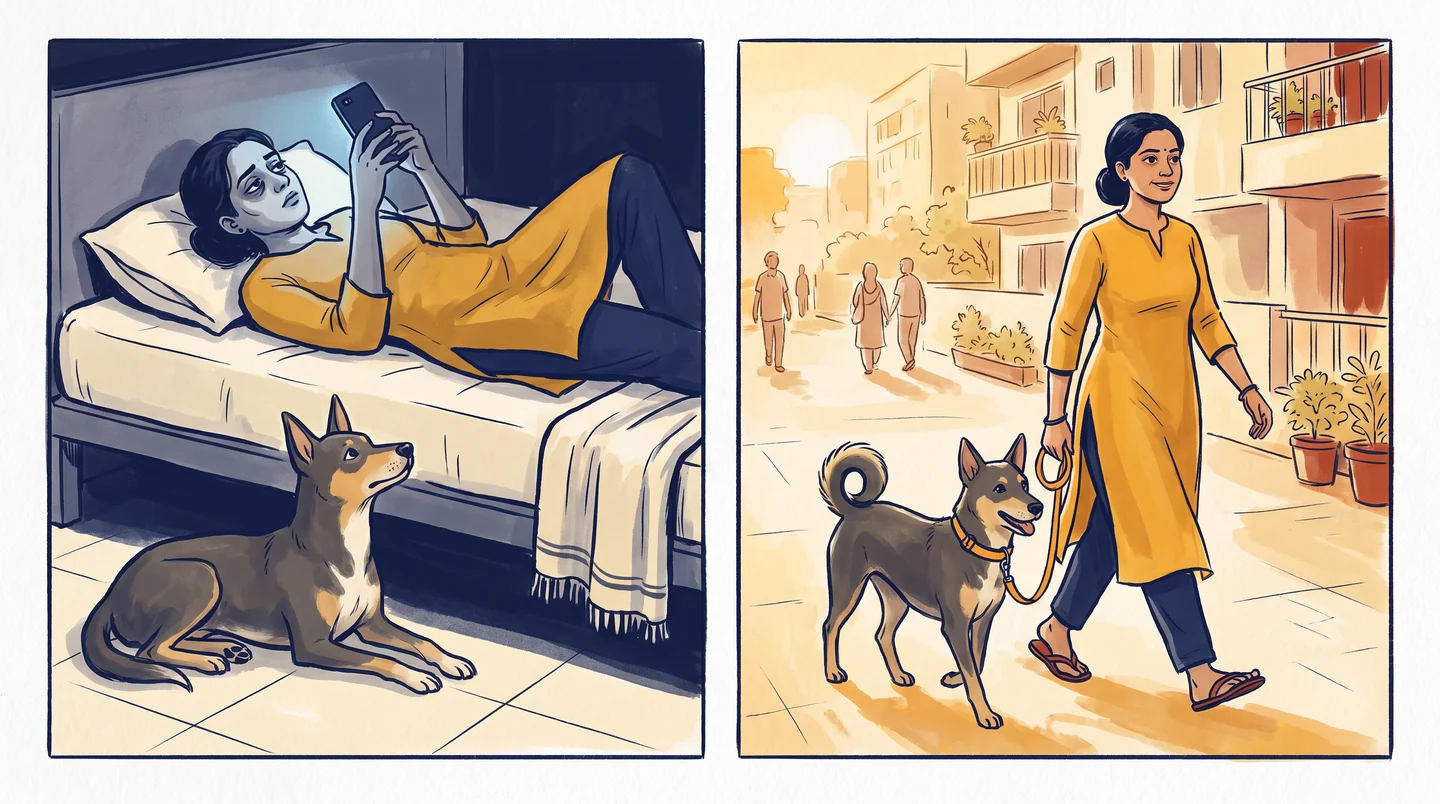
And one thing for you. People ask why a dog course has a section on the human's growth. Because the dog reads you, every hour of the day. If I am frustrated inside, or anxious, or low, my dog is feeling it, and learning that was the single biggest reason I started working on myself. So the plan asks you to find one habit of yours that is not serving you, and you already know which one, and swap it for one that does. Not ten. One. You eat sweets at night. You scroll in bed. You sleep at no fixed time. You watch one episode and it becomes six. You know yours. Choose a good one to put in its place, and let the dog be part of it: the walk you take with him gets longer, built up over a couple of weeks, and kept to the early morning and the evening when it is hot, which is exercise for him and for you, and a habit with two beneficiaries holds better than a habit with one.
 , open the figure larger
Then run the ninety days. If it slips, there is no failure in it. Start the ninety again.
What to do tonight
Write the six answers. Walk, meeting, discipline, feeding, play, affection. For each one, the honest picture today, including what you feel, not just what he does. Then read the three circles over your answers: the dog, you, and the two of you together.
Then set the three times in your diary. Walk, play, food. Do not start them tomorrow. Give the reading its three days first. But set them, because a time written down has already begun to become a habit.
In the next chapter we go to the dog himself: what he is, before he is a breed or a name, and how he reads the world you share with him. It will change the way you read your own six answers.