Key Takeaways
- Senses switch on in a fixed order: touch first, then the chemical senses (smell and taste) and balance, then hearing, and sight last, a sequence that is consistent across mammals and well documented in puppies after birth [1][2].
- A puppy is born blind and deaf. The eyelids are fused and the ear canals are closed; eyes open around 10-14 days and ears around two weeks [3][6].
- Smell and a heat-seeking thermal sense are working at birth, and a newborn uses them, with touch and the rooting reflex, to find the mother's warmth and milk [9][10][11].
- The socialization window (≈3-12 weeks) is when the senses sharpen into a working dog, and what a puppy experiences in this window shapes it for life [1][2].
- The womb is not a sensory blank. Touch, balance, and chemical senses begin developing before birth, and significant maternal stress during pregnancy is linked to more reactive puppies, though much of the fine detail is inferred from other species [4][5].
Why a puppy's first senses are built before it can see or hear
A newborn puppy looks helpless. Eyes sealed, ears closed, barely able to crawl. It is easy to assume that not much is happening yet. The opposite is true: the most important sensory wiring of a dog's life is being laid down in exactly this period, and a lot of it started before birth.
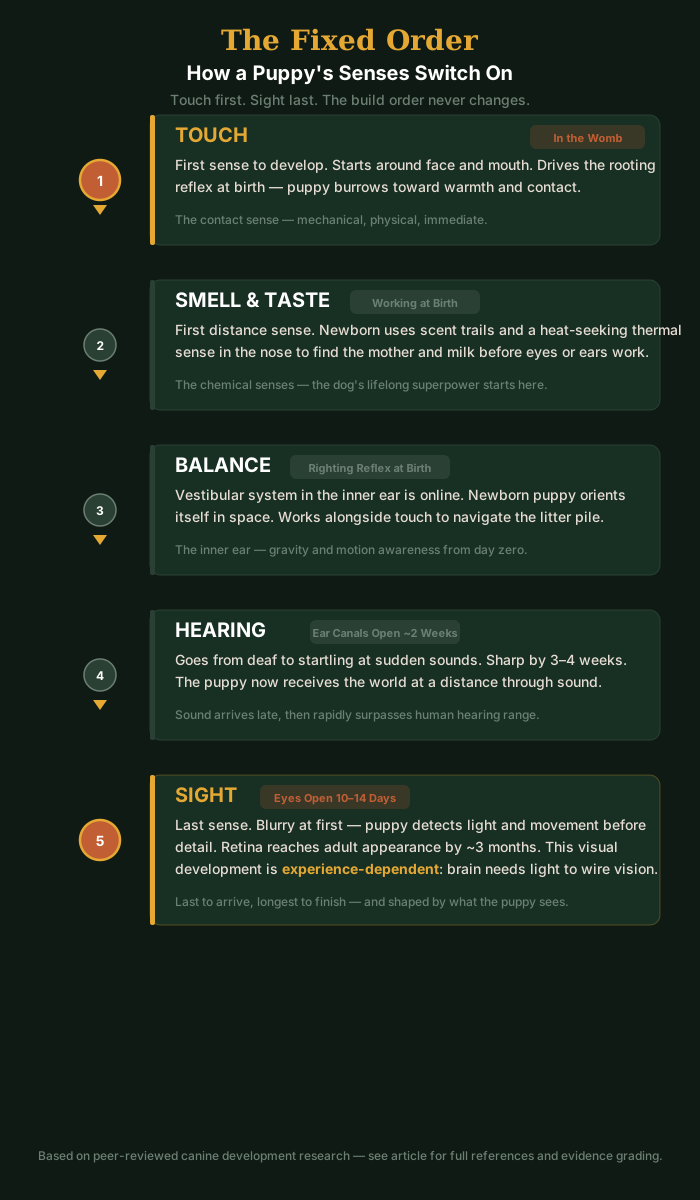
Senses do not all arrive at once. They switch on in a reliable order, touch, then smell, taste and balance, then hearing, and finally sight. This order is not random. It mirrors how the nervous system matures, and it is remarkably consistent across mammals [1][2]. Knowing the sequence changes how you raise a puppy, because it tells you which "channel" a young dog is actually living through at each stage.
This article walks that journey from the womb to the wider world. We have graded the evidence on purpose. Some of it, when eyes and ears open, how the socialization window works, is solid and repeatable. Some of it, especially what a puppy senses in utero, is largely inferred from other species because you cannot easily study a sensation a fetus cannot report. We will say which is which.
The six windows from conception to the wider world
Modern canine science divides early development into six overlapping windows, building on the foundational four-stage model from Scott and Fuller's 1965 work and refined in later reviews [1][2]. Each window has a dominant sensory story.
| Period | Age | What the senses are doing |
|---|---|---|
| Prenatal | The ~9-week pregnancy | Touch, balance, and chemical senses begin forming; the fetus can be influenced by the mother's state [1][4] |
| Neonatal | Birth to ~2 weeks | Blind and deaf; runs on smell, touch, taste, warmth, and balance [2][9] |
| Transitional | ~2 to 3 weeks | Eyes and ear canals open; sight and sound switch on [3][6] |
| Socialization | ~3 to 12 weeks | All senses sharpen; experience wires lifelong responses [1][2] |
| Juvenile | ~12 weeks to 6 months | Senses are adult-grade; refinement and learning continue [1] |
| Pubertal | ~7 to 24 months | Physical and social maturation [1] |
The first four windows are where the sensory system is actually built. That is where we will spend most of our attention.
In the womb: what a puppy can sense before birth
Touch is the first sense to develop, and it develops before birth. In mammals broadly, tactile sensitivity appears early in gestation, beginning around the face and mouth and spreading outward [1]. The sense of balance, the vestibular system in the inner ear, also comes online early, which is why a newborn puppy already has a righting reflex and can orient itself the moment it is born. The chemical senses begin forming too: a fetus is bathed in amniotic fluid that carries flavour and odour molecules from the mother's diet, the same mechanism shown to shape later food preferences in other mammals.
Here is the honest caveat. Direct measurement of what a canine fetus feels is scarce. You cannot ask a puppy in the womb what it notices. So the sequence above is a robust, cross-species pattern, and the postnatal canine timeline is well documented, but the precise in-utero detail for dogs specifically is largely extrapolated. Treat it as a well-founded direction, not a stopwatch.
What is better supported in dogs is that the womb is not neutral. Significant stress in a pregnant dam is associated with puppies that are later more fearful, more reactive, and less able to cope with stress, an effect thought to work through fetal "glucocorticoid programming," where stress hormones during pregnancy recalibrate the offspring's own stress system [4][5]. Much of the fine mechanism comes from rodent models, but the direction is consistent enough that a calm, well-cared-for pregnant mother is a reasonable, evidence-aligned goal [4].
Birth to two weeks: a world of smell, warmth, and touch
For roughly the first two weeks, a puppy is blind and deaf, and it does not matter as much as you would think, because the senses it does have are enough to run its tiny world. The eyelids are fused and the ear canals are sealed, so vision and hearing are simply offline [2][3]. What is left is a rich set of near-senses: smell, taste, touch, warmth, and balance.
Smell is the hero of this period. A puppy's sense of smell is functional at birth, and newborns use scent to locate the mother and orient toward her milk [9]. Working alongside it is a thermal sense, heat detectors in the nose region that help a pup home in on the warmth of the mother and littermates [10][11]. Add the rooting reflex (the puppy burrows into any warm, soft surface and pushes toward it) and you have a complete, if primitive, navigation system: smell plus warmth plus touch, all pulling the puppy toward food and safety [11].
This is why neonatal puppies pile together and why a chilled, separated newborn is in real danger. It has lost the warmth signal it is built to follow. It is also why this stage is so physical. A puppy at one week old experiences love almost entirely as contact, warmth, and smell. Sight and sound are not part of its world yet.

Two to three weeks: the lights and sound come on
The transitional period is short and dramatic: in the span of about a week, two whole senses come online. The eyes open at roughly 10-14 days, though at first vision is blurry, the puppy detects light and movement long before detail [3][5]. Within days of that, the ear canals open at around two weeks, and the puppy goes from deaf to startling at sudden sounds [6].
| Sense | When it switches on | Early quality |
|---|---|---|
| Vision (eyes open) | ~10-14 days | Blurry; light and motion only at first [3][5] |
| Hearing (ear canals open) | ~2 weeks; sharp by 3-4 weeks | Startle to sound first, then rapid tuning [6] |
You can often watch this transition happen. A breeder dropping a set of keys near a two-and-a-half-week litter will see the puppies flinch, sometimes for the very first time. That flinch is a milestone: the sound channel has just opened. From here the puppy is no longer a creature of pure smell and touch. It begins to receive the world at a distance, through light and sound, and its brain starts the long job of making sense of both.

This is also why some breeders describe the temporary newborn deafness as protective: the inner ear can finish maturing without being battered by loud noise before it is ready [6]. Whether or not that framing is the full story, the practical takeaway holds, sound and sight arrive together, late, and fast.
Three to twelve weeks: the senses sharpen into a working dog
This is the window that matters most for the dog you will live with. Once the eyes and ears are open, the senses do not just exist. They sharpen, and they do so through use. Hearing becomes sharp by about 3-4 weeks and then keeps refining until it far outstrips ours. Vision keeps improving over the first weeks and months as the eye and the visual brain wire together, with the retina reaching its adult appearance by around three months [3][5]. Crucially, this visual development is experience-dependent: the brain needs real light and visual input through the eyes to build normal vision [5].
That word, experience-dependent, is the whole point of the socialization period (roughly 3 to 12 weeks). The senses are now open, and the brain is using whatever they take in to wire its lifelong responses [1][2]. A puppy that hears household noise, sees different people, feels varied surfaces, and smells the ordinary mess of the world during this window builds a nervous system that treats those things as normal. A puppy kept in a blank, quiet, identical environment can build a nervous system that finds the ordinary world alarming. The same sensory machinery, two very different dogs.
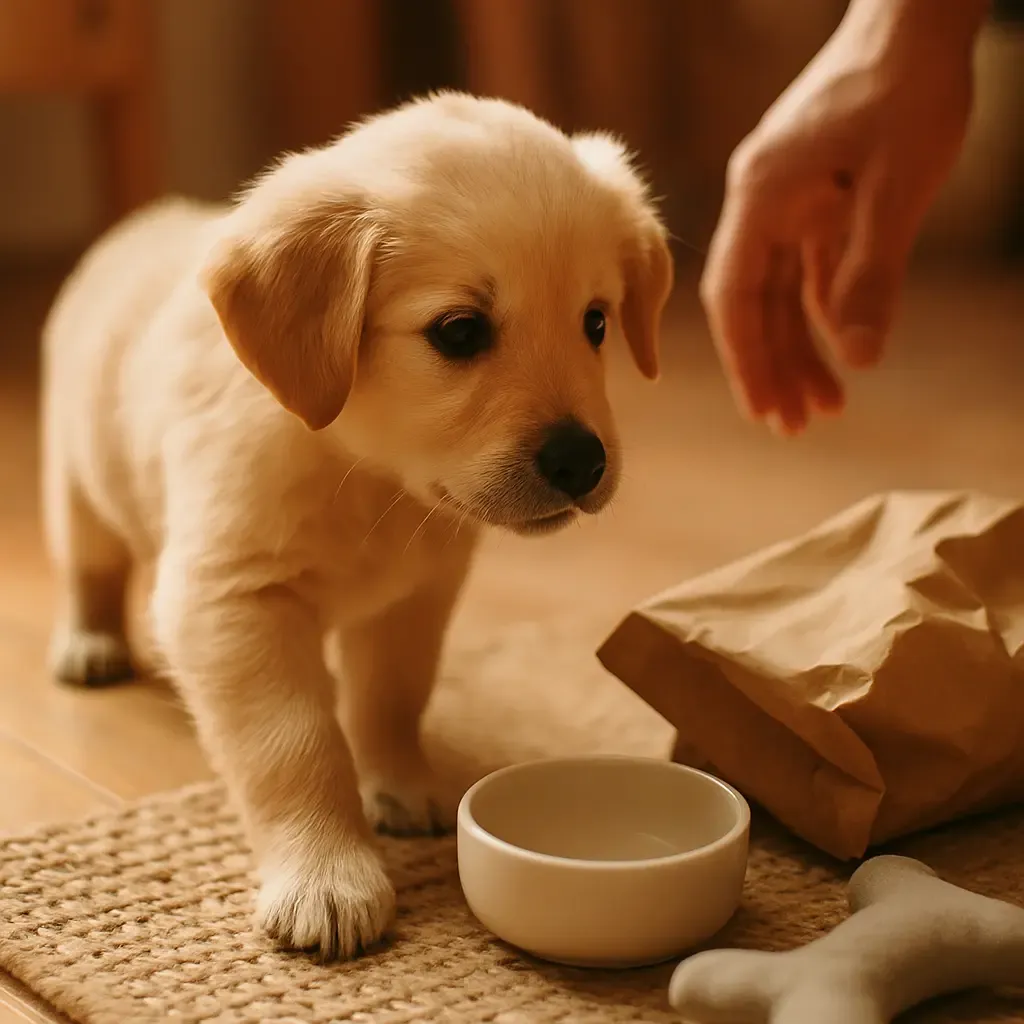
This is why early, gentle, varied experience is not "spoiling" a puppy. It is sensory construction work, happening on a deadline. Reviews of canine development consistently identify this window as a sensitive period whose effects are hard to fully undo later [1][2]. Exact timing varies a little by breed, but the principle is universal [1].
A sense-by-sense timeline
Pulling the threads together, here is the order in which a dog's world assembles itself. The earlier a sense appears, the more central it is to how a young puppy actually experiences life.
| Sense | First appears | Notes |
|---|---|---|
| Touch | In the womb (first sense) | Starts around face and mouth; drives rooting and contact-seeking at birth [1][11] |
| Balance (vestibular) | In the womb / at birth | Righting reflex present in the newborn [2] |
| Smell | Working at birth | First distance sense; locates the dam and milk; strongest sense for life [9] |
| Thermal sense | Working at birth | Heat-seeking; helps find the warmth of mother and littermates [10][11] |
| Taste | Working at birth | Tied to suckling and early flavour exposure [2] |
| Hearing | Ear canals open ~2 weeks | Startle first, sharp by 3-4 weeks, then surpasses human hearing [6] |
| Sight | Eyes open ~10-14 days | Blurry first; retina adult-like by ~3 months; experience-dependent [3][5] |
The pattern is consistent: the contact and chemical senses lead, and the distance senses, hearing and especially sight, arrive last and take longest to finish.
The senses switching on
01 / 06
- Touch
- forming
- Smell & taste
- not yet
- Balance
- forming
- Hearing
- not yet
- Sight
- not yet
Window 01 · the ~9-week pregnancy
Prenatal
Touch begins forming around the face and mouth, and the vestibular system starts to come online. The fetus is bathed in amniotic fluid carrying flavour molecules from the mother’s diet.
How strong is the evidence, honestly?
Not every claim in this article carries the same weight, and we would rather you trust us than be impressed by us. Here is the same story, graded.
| Claim | Evidence strength | Why |
|---|---|---|
| Eyes open ~10-14 days; ears open ~2 weeks | Strong | Directly observed, repeatable, vet-documented [3][5][6] |
| Smell and thermal sense work at birth | Strong | Demonstrated in newborn-puppy feeding studies [9][11] |
| Touch is the first sense, developing in the womb | Strong (cross-species) | Robust mammalian pattern; canine in-utero detail is inferred [1] |
| The 3-12 week socialization window shapes lifelong behaviour | Strong | Consistent across decades of canine development research [1][2] |
| Maternal stress in pregnancy affects puppies | Moderate | Supported in dogs; mechanism largely from rodent models [4][5] |
| Early Neurological Stimulation produces lasting "super dogs" | Weak / mixed | Popular in breeding; controlled evidence in dogs is limited [7] |
| Adult dogs sense weak thermal radiation with the nose | Emerging | A single 2020 study; intriguing but not yet built on [10] |
So: the postnatal sensory timeline is solid. The womb story is directionally well-founded but thinner on canine-specific data. And the popular breeder practices built on top of this science, we will come to those, sit on softer ground than their marketing suggests.
What this means for raising a puppy
The practical lessons fall straight out of the timeline. You do not need gadgets. You need to meet the puppy in whichever sense is currently switched on.
Before birth, support the mother. Because significant maternal stress is linked to more reactive offspring, a calm, comfortable, well-fed pregnant dog is doing developmental work for her puppies, not just resting [4][5]. The dam's early gut and overall health also seed the litter: a newborn's microbiome is colonised from the mother and environment in these first days, and that early gut development underpins a lot of later health, a theme we cover in the gut-immune connection in dogs. For dogs whose guts are under pressure, a soil-based support like ProBelly is one honest lever among many.
In the first two weeks, think smell, warmth, and touch. This is not the stage for sights and sounds the puppy cannot receive. It is the stage for gentle handling, stable warmth, and keeping the litter together. Some breeders add Early Neurological Stimulation, a brief daily handling routine on days 3-16 popularised by a US military "Bio Sensor" program, to mildly stress and stimulate newborns [7]. It is plausible and low-cost, but the controlled evidence that it creates measurably better adult dogs is limited, so we file it under "reasonable, not proven" [7].
From 2-3 weeks onward, gently widen the world. As hearing and sight come on, ordinary household sounds, surfaces, and gentle handling start to matter. Then, through the 3-12 week socialization window, varied and positive experience is the single highest-leverage thing you can give a puppy, because its senses are wiring lifelong responses in real time [1][2]. Keep it positive and not overwhelming, the goal is "the world is normal and safe," not flooding.
The OhMyDog takeaway
A puppy does not arrive as a blank slate that suddenly wakes up when its eyes open. It arrives mid-construction, on a fixed build order, touch and smell and balance first, sound and sight last, with the most important wiring happening in the weeks when it looks like nothing is going on.
That changes the job. Raising a young puppy well is not about teaching commands to a creature that cannot yet see you clearly. It is about feeding the right sense at the right time: warmth and contact in the blind, deaf weeks; a calm, varied, positive world once the lights and sound come on. Get the sequence right and you are not just raising a puppy. You are helping build the nervous system of the dog it will spend its whole life being.
Curious where your own dog's development and health sit now? Our wider research library digs into the gut, behaviour, and lifecycle science behind everyday dog care.
Drafted with AI from peer-reviewed and veterinary canine-development research, then verified line by line by Sunny Luthra, dog behaviourist and founder of OhMyDog.Rocks. This article is for education only and is not a substitute for advice from your veterinarian. If you are caring for a pregnant dog or a neonatal litter, work with your vet, newborn puppies can decline quickly.
References
- McEvoy V, Espinosa UB, Crump A, Arnott G. "Canine Socialisation: A Narrative Systematic Review." Animals, 2022. pmc.ncbi.nlm.nih.gov/articles/PMC9655304 (accessed 20 June 2026).
- Scott JP, Fuller JL. Genetics and the Social Behavior of the Dog. University of Chicago Press, 1965, the foundational four-period model (neonatal, transitional, socialization, juvenile). Summarised in University of Illinois ANSC 207 course notes (accessed 20 June 2026).
- "When Do Puppies Open Their Eyes? Vet-Verified Age & Vision Development Facts." Dogster (vet-reviewed). dogster.com/dog-health-care/when-puppies-open-eyes (accessed 20 June 2026).
- USDA APHIS Animal Care. "Animal Care Aid: Maternal Stress and Puppy Development" (AC-19-005), 2019. aphis.usda.gov (accessed 20 June 2026).
- Veterinary Vision Center. "Pediatric Ophthalmology: Eye Development in Puppies and Kittens." veterinaryvisioncenter.com (accessed 20 June 2026).
- "When Do Puppies Start Hearing? What to Expect." Dogster (vet-reviewed). dogster.com/dog-health-care/when-do-puppies-start-hearing (accessed 20 June 2026).
- Battaglia C. "Early Neurological Stimulation." American Kennel Club. akc.org/expert-advice/dog-breeding/breeder-puppy-socialization-early-neurological-stimulation (accessed 20 June 2026).
- Croney Research Group. "At-A-Glance: Puppy Development and Maternal Prenatal Stress." Purdue University Center for Animal Welfare Science. caninewelfare.centers.purdue.edu/resource/at-a-glance-puppy-development-maternal-stress-croney-research-group (accessed 20 June 2026).
- "Role of smell in the food-seeking activity of newborn puppies." PubMed (PMID 3709874). pubmed.ncbi.nlm.nih.gov/3709874 (accessed 20 June 2026).
- Bálint A, et al. "Dogs can sense weak thermal radiation." Scientific Reports, 2020. pmc.ncbi.nlm.nih.gov/articles/PMC7048925 (accessed 20 June 2026).
- "The normal neonate: What is normal and abnormal?" dvm360, newborn puppy reflexes, including rooting. dvm360.com/view/normal-neonate-what-normal-and-abnormal-proceedings (accessed 20 June 2026).